
That is how predictable this tour has been. In each of the three ODIs and two T20Is before Sunday, the chasing side had not only won but made a mockery of the targets, whether it was 406 (third ODI) or 250 (second T20I). Looking at you and your Instagram posts, Shubman Gill and Shai Hope!
Given the short boundaries at the Holkar Stadium (63 metres square, 72 metres straight), a high-scoring game was always on the cards. Experts predicted totals in excess of 250; a placard in the stands asked for 300.
“I knew they had a plan against me – the offspinner bowling the first over,” he said after the game. “So it was a battle between him and me. I gave him the respect in the first over, because I think he has been bowling really well in this series.”
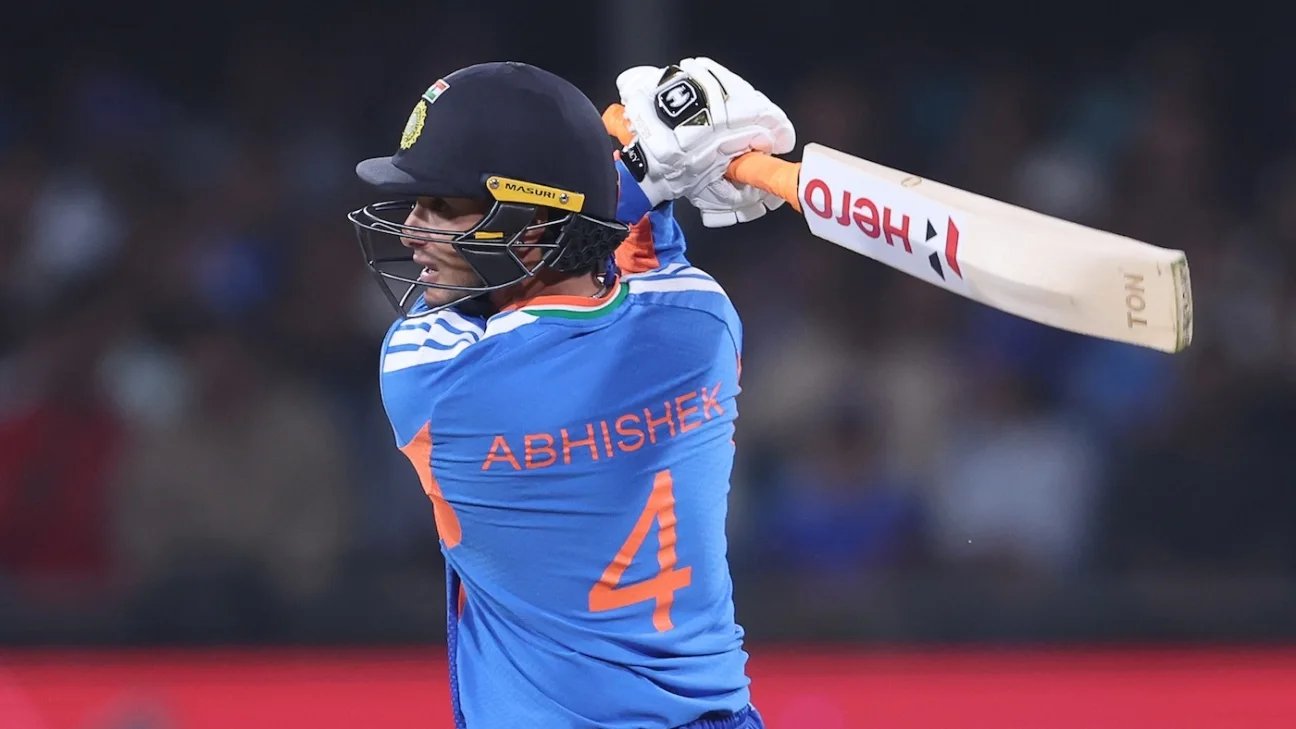
Once the respect was out of the way, Abhishek showed what makes him such a dangerous batter. Despite the cautious start, he finished with 69 off 30 balls. But what made the knock stand out was his hitting through the off side.
In the third over of the innings, Chase darted one full at 111.6kph. Abhishek stepped away and smashed it through the covers for his first boundary. In an attempt to buy his wicket, Chase slowed down the next delivery to 86.9kph, but Abhishek again gave himself room and launched it over wide long-off for a six. Two balls later, he repeated the dose, this time over the covers. In just four balls, his strike rate had zoomed from 100 to 233.33.
That assault forced Hope’s hand. Despite two left-hand batters at the crease – Ishan Kishan being the other – he had to take Chase off.
Shamar Springer replaced him, and later said West Indies’ Plan B against Abhishek was to be “as defensive as possible”. It didn’t work. Abhishek hit Springer for 4, 4, 6 off successive deliveries, all through the off side.
Of his 69 runs, 50 came through the off side – a staggering 72.5%. Never before in a T20I innings of 50 or more had he scored a higher percentage of runs on that side
Shamar Joseph was not spared either. The acceleration was such that Abhishek soon brought up his fifty – off 18 balls, inside the powerplay. In the process, he became the fastest to 2000 T20I runs, getting there in just 1024 balls, a full 140 fewer than Suryakumar Yadav’s earlier record of 1164.
Seeing things go awry, the West Indies seamers turned to yorkers, both straight and wide. But they kept missing their lengths and Abhishek kept slicing them through the arc between cover and point. The best of the lot came against Joseph. As Abhishek stepped out and made room, the fast bowler followed him with a yorker. He took it on the full, opened the face of the bat and steered it through the gap between point and cover. The deep point fielder had been moved just before that delivery, leaving Joseph with only a wry smile.
Chase did return later to dismiss Kishan and Iyer in the same over, underlining how much Abhishek’s initial attack on him had mattered. Abhishek himself fell in the tenth over, but by that time India had raced to 124. They would eventually post only 223, but they knew it was probably not an easy pitch to score on.
The near-absence of dew further tilted the scales in India’s favour. That also means we still do not know whether 223 was dew-proof, but for the first time on the tour, a team successfully defended a total.
Hemant Brar is a sub-editor at Cricinfo
