
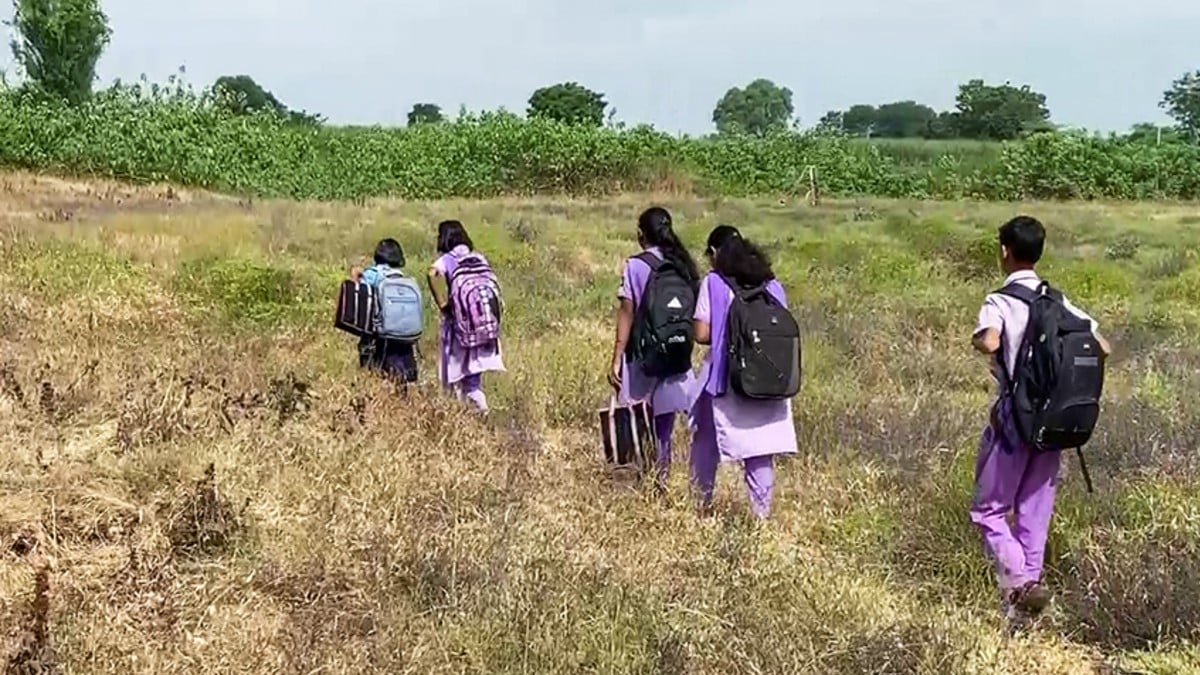
New Delhi: For every 100 boys completing upper secondary education (Class 11 and 12) in rural India, only 50 girls do so, according to a new UNESCO report released Friday that highlights a stark divide in school completion despite progress towards parity in urban areas.
The report, titled Gender Equity in Access to Education, examines gender gaps in education across 31 low- and middle-income countries. India’s adjusted gender parity index for upper-secondary completion is 0.89 overall, 0.59 in rural areas and 1.0 in urban areas.
Upper-secondary completion at 0.89 overall implies that, for every 100 boys completing this level of education, about 89 girls do so.
The figure drops to 59 girls for every 100 boys in rural areas, while urban areas have achieved parity.
A gender parity index of 1 indicates equal outcomes for girls and boys.
In India’s case, the rural figure points to a substantial gap in the proportion of girls and boys completing upper-secondary education.
The report highlights how national-level progress can mask disparities between different groups. “Progress towards gender parity does not mean that all groups of children benefit equally from that trend,” it says.
Also Read: In rural India, 82.2% teens aged 14-16 know how to use smartphone but only 57% use it for studies
Rural girls face a wider gap
The report analyses differences in upper secondary completion by location and household wealth across 31 low- and middle-income nations with data from 2020-24. It states that in countries where girls are disadvantaged, a median gender parity index was 0.87. It fell to 0.74 in rural areas compared to 0.96 in urban areas.
Whereas, India reflects this wider pattern, with rural girls facing a pronounced disadvantage even as urban areas have reached parity.
India’s rural-urban divide is also reflected in school enrolment data. The ASER 2024 report found that 8.1 percent of rural girls aged 15-16 were not enrolled in school, up from 7.9 percent in 2022. While these figures measure current enrolment rather than completion, they point to continuing challenges in keeping older girls in education.
The UNESCO report found that in countries where girls face educational disadvantages, the median gender parity index was 0.66 among the poorest households, compared with 0.92 among the richest 20 percent, highlighting how poverty widens the gender gap in education.
The report does, however, underline the role of overlapping disadvantages in shaping access to education. “Gender disparity in access to education does not result from individual choices, but rather from political, economic, social and cultural mechanisms, as well as education policies and practices that exclude children, adolescents and young people,” it says.
Such disparities, the report adds, are best understood through “the interaction between sex and factors such as poverty, geography and the norms associated with belonging to a social or demographic group”.
Policies need to address practical barriers
The report argues that improving girls’ access to education requires addressing the practical barriers that prevent them from enrolling, attending school regularly and completing their education. These include the cost of transport, unsafe school environments, inadequate sanitation facilities and the lack of support for girls who leave school because of pregnancy or early marriage.
It draws on India-specific research to highlight the impact of targeted interventions. Studies cited by UNESCO found that the national latrine-construction initiative increased enrolment among adolescent girls, particularly in areas where separate toilets for boys and girls were provided.
Research from India also links early and consistent access to school meals with lower dropout rates, especially among girls. A randomised trial across 121 villages in Karnataka found that local clubs offering girls life skills and opportunities to build social networks modestly improved secondary-school completion, although early marriage remained a concern.
The report cites Nepal as an example of how sustained policy interventions can narrow gender gaps. Girls’ overall secondary completion in Nepal rose from 8 percent in 1990 to 89 percent in 2024, reaching parity with boys. UNESCO attributes the progress partly to laws guaranteeing free and compulsory basic education, targeted scholarships, improved school facilities and examination reforms that made progression to higher grades easier.
However, the report cautions that individual interventions may not be enough if other barriers persist. “Abolishing fees does not make education free if transport is unaffordable. Scholarships count for little if schools are unsafe. Re-entry policies cannot be effective if young mothers lack childcare,” it says.
(Edited by Amrtansh Arora)
Also Read: India’s school system is failing the test. NITI Aayog flags dropouts, weak learning outcomes