
Sample characteristics
The study included healthcare professionals from nursing, medicine, pharmacy, and dentistry, with equal representation from each discipline (25%). Most participants were aged 29–35 years (36.9%) and 36–40 years (36.3%), with a mean age of 37.65 ± 5.31 years. Females constituted 61.3% of the sample, while males accounted for 38.8%. In terms of qualifications, postgraduate professionals in medicine and dentistry each comprised 25%, followed by nursing (20.6%) and pharmacy (16.9%). Nearly half of the participants were Assistant Professors (48.8%). The majority had 7–10 years of teaching experience (37.5%) and 6–10 years of research experience (37.5%), indicating a moderately experienced workforce. Detailed sample characteristics are presented in Table 1.
Usage of different types of AI tools by healthcare professionals in research
The findings demonstrated that healthcare professionals utilized a wide range of AI-assisted and digitally supported research tools in their academic and research activities. In the present study, the term “AI tools” was used broadly to include generative AI applications, AI-assisted writing and language platforms, AI-supported literature search engines, semantic research tools, and advanced analytical applications that incorporate artificial intelligence or machine learning algorithms to support research-related functions.
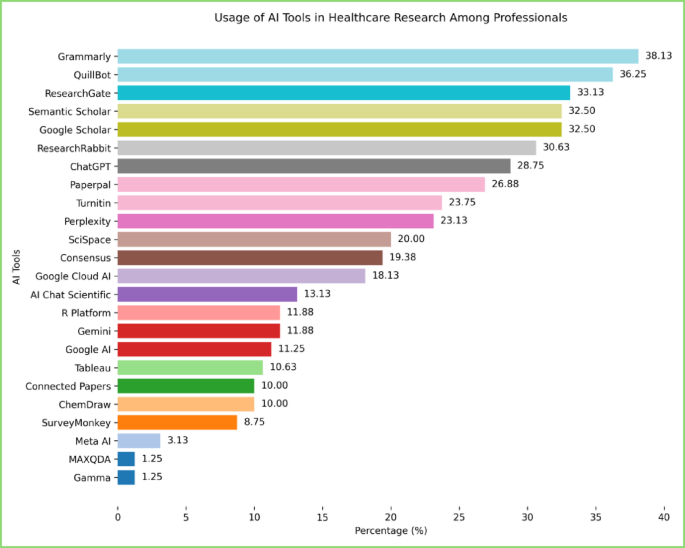
Healthcare professionals reported the use of a wide range of AI-assisted and digitally supported research tools in their academic and research activities. Grammarly and QuillBot were the most frequently utilized tools, indicating a strong preference for AI-assisted writing, grammar correction, paraphrasing, and language enhancement. AI-supported literature search and research networking platforms such as ResearchGate, Google Scholar, and Semantic Scholar were also widely used for literature retrieval, citation support, semantic search, and scholarly communication. Moderate utilization was observed for ResearchRabbit, ChatGPT, Paperpal, Turnitin, Perplexity, and SciSpace, reflecting their growing role in manuscript drafting, plagiarism checking, summarization, referencing, and evidence synthesis. In contrast, advanced analytical and visualization tools, including Google Cloud AI Platform, Gemini, R Platform, and Tableau, were comparatively less utilized. Minimal adoption was reported for Meta AI, Gamma, and MAXQDA. Overall, the findings suggest that healthcare professionals relied more on AI-assisted tools for writing and literature-related activities than for advanced analytical and methodological research applications. The percentage distribution of AI-assisted research tools used by healthcare professionals is presented in Fig. 1.
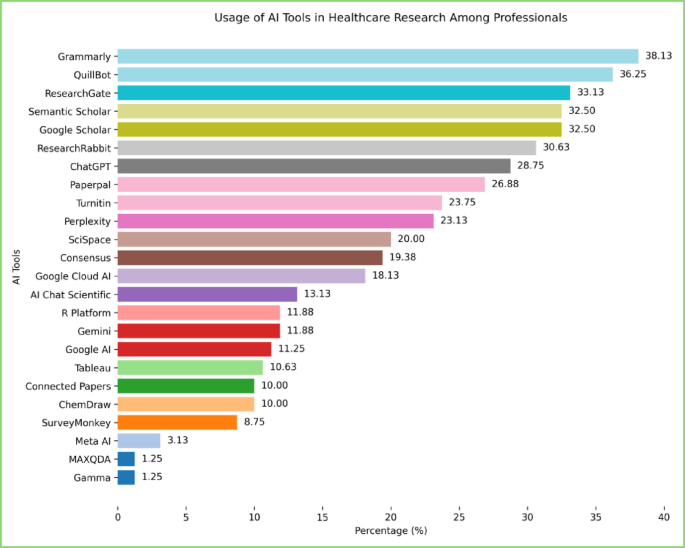
Percentage distribution of AI tools used in healthcare research among professionals. The figure shows the usage pattern of various AI-assisted research tools, highlighting greater reliance on writing and literature-support applications than advanced analytical tools.
Perception toward AI and utilization of AI in healthcare research
Healthcare professionals demonstrated an overall moderate perception toward AI in healthcare research, with the majority reporting a neutral perception and a smaller proportion indicating a positive perception. Sub-domain analysis showed relatively higher scores in awareness and perceived benefits, suggesting adequate familiarity with AI applications in research. However, comparatively lower scores related to limitations, cost and feasibility reflected concerns regarding ethical issues, infrastructure, accessibility, and affordability of AI technologies.
With regard to utilization, most participants demonstrated moderate to low use of AI tools in healthcare research, indicating limited practical integration of AI into research activities. AI tools were more frequently utilized for general research support, statistical analysis, and manuscript preparation, whereas lower utilization was observed in research methodology-related activities, suggesting cautious adoption of AI in core research design processes. Overall, the findings indicate that although healthcare professionals possess reasonable awareness and favorable perceptions of AI, its practical application in advanced research activities remains limited. Detailed findings are presented in Fig. 2.
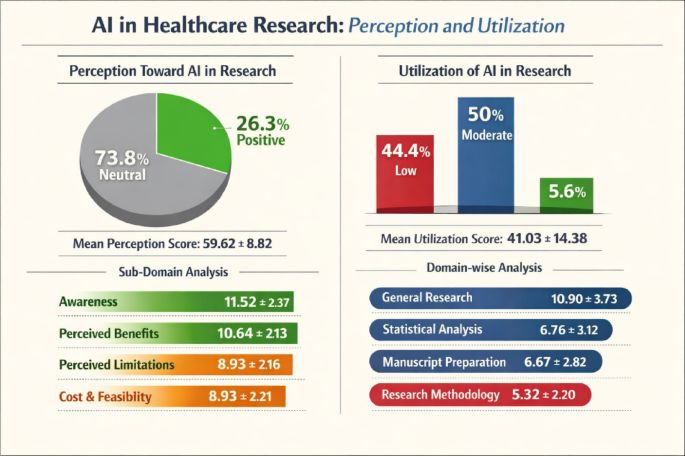
Perception and utilization of AI in healthcare research among professionals. The figure presents levels of perception and utilization of AI among healthcare professionals across different domains of healthcare research.
Comparison of perception and utilization of AI among healthcare professionals
Table 2 shows significant differences in perception and utilization of AI among nurses, doctors, pharmacists, and dentists across several domains. Significant variations in perception were observed in awareness, comprehension, perceived benefits, disadvantages, and availability/barriers (p < 0.001), indicating differences in understanding and attitudes toward AI among professional groups. However, no significant difference was found in the domain of cost and feasibility (p = 0.152), suggesting similar concerns regarding affordability and implementation challenges across professions.
Similarly, utilization of AI differed significantly across professional groups in domains related to protocol drafting, methodology preparation, statistical analysis, publication activities, and overall research support (p < 0.05). These findings indicate variability in the practical application of AI tools in healthcare research among different professional categories. In contrast, manuscript preparation did not demonstrate a statistically significant difference among the groups (p = 0.127), suggesting relatively similar use of AI tools for writing-related activities. Overall, the results highlight considerable disciplinary variation in both perception and utilization of AI in healthcare research.
Relative importance of utilization of artificial intelligence in healthcare research among professionals
The Relative Importance Index (RII) analysis demonstrated varying levels of AI utilization across different healthcare research activities. Higher utilization was observed for automating research tasks, generating graphical outputs, and grammar correction, indicating greater reliance on AI for supportive and technical research functions. Moderate utilization was identified in areas such as statistical analysis, literature review automation, dataset management, and paraphrasing, reflecting the growing integration of AI into routine research processes.
In contrast, lower utilization was observed in core research activities, including methodology design, manuscript formatting, interpretation of statistical results, identifying research gaps, and structuring research protocols. These findings suggest that healthcare professionals primarily utilize AI for writing, automation, and visualization-related tasks, whereas its adoption in methodological and analytical decision-making processes remains limited. Overall, the results highlight the need for targeted training, improved awareness, and institutional support to promote effective and responsible integration of AI into healthcare research practices (Table 3).
Regression analysis of perception and utilization of AI
Multiple linear regression analysis was performed to identify factors associated with perception and utilization of AI in healthcare research among professionals. The regression model for perception was statistically significant and explained 15.6% of the variance in perception scores. Among the studied variables, professional designation emerged as the only significant predictor, indicating that perception toward AI varied according to professional role, while age, gender, qualification, years of experience, research experience, and area of specialization did not show significant associations.
For utilization, the regression model demonstrated comparatively higher explanatory power, accounting for 48.4% of the variance in AI utilization. Significant predictors included professional designation, research experience, and area of specialization, suggesting that academic role, involvement in research activities, and disciplinary background significantly influenced the utilization of AI in healthcare research. In contrast, age, gender, qualification, and general professional experience were not identified as significant predictors. Overall, the findings indicate that professional and research-related characteristics play an important role in determining the practical utilization of AI among healthcare professionals (Table 4).