
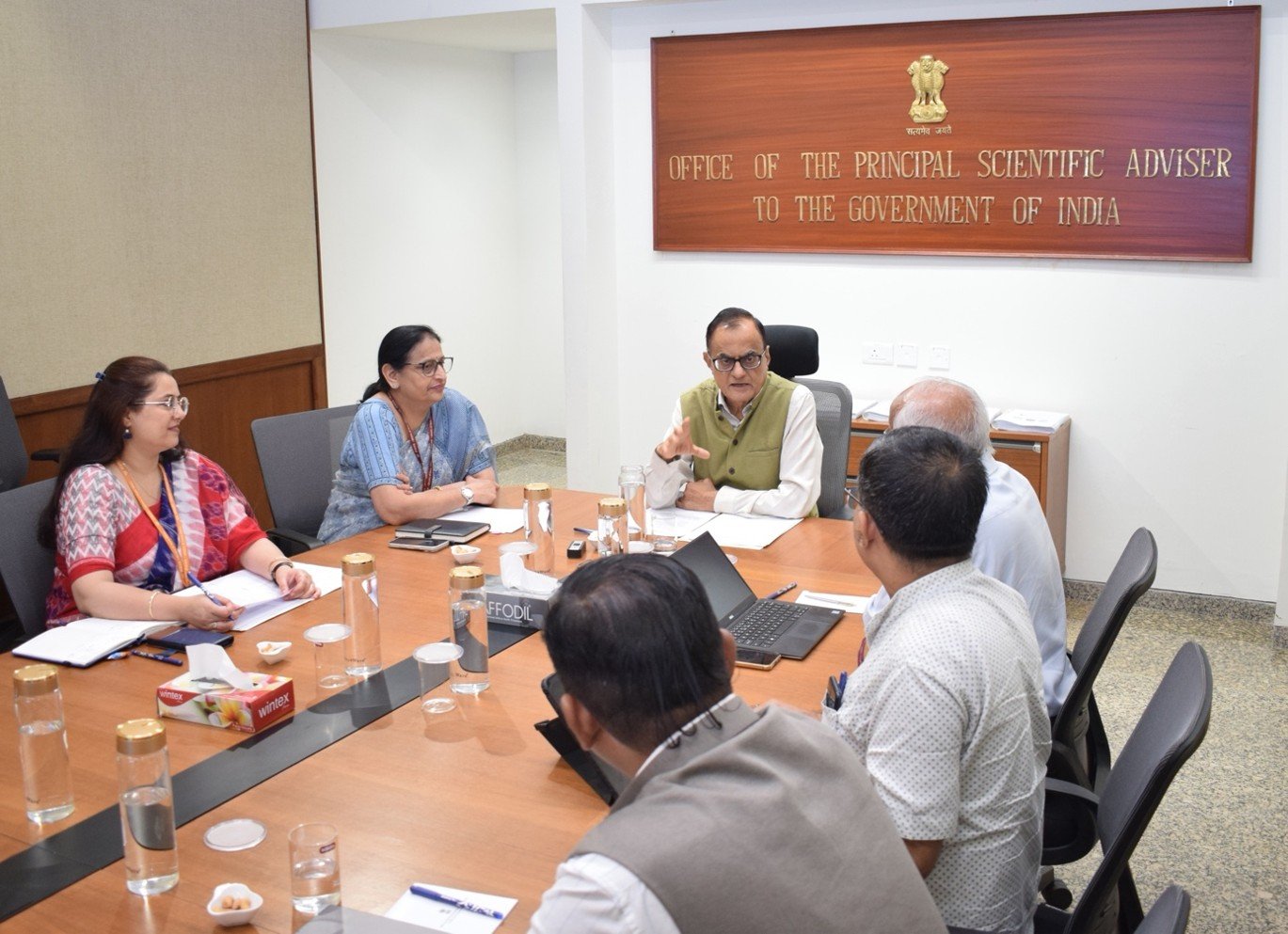
Prof. Ajay Kumar Sood, Principal Scientific Adviser (PSA) to the Government of India, chaired a meeting on 16 September 2026 to review the outcomes and recommendations of the project ‘Development of LCA Framework for Solid Waste Management (SWM) Technologies in India’. Dr Parvinder Maini, Scientific Secretary, also graced the meeting, which brought together Dr Vishal Chaudhary, Scientist ‘F’; Dr Hafsa Ahmad, Scientist ‘D’, from the Office of the PSA; Ms. Shravanthi, Deputy Adviser, Central Public Health and Environmental Engineering Organisation, Ministry of Housing and Urban Affairs; and Prof. M.S. Mohan Kumar, Prof. (Retd.), Department of Civil Engineering, IISc Bengaluru and Chair, Project Review Monitoring Committee. The project consortium included Prof. Lakshminarayana Rao and Prof. Chanakya Hoysall from IISc Bengaluru, Prof. R. Vinu from IIT Madras, and Prof. R. S. Singh from IIT (BHU) Varanasi, along with key research associates responsible for LCA modelling, GHG accounting, and digital tool development. Representatives from invited Urban Local Bodies (ULBs) also joined the meeting virtually.
Aligned with the vision of national missions like the Waste to Wealth Mission and the Swachh Bharat Mission-Urban, the Office of the PSA supported the project in 2024, which was jointly undertaken by IISc Bengaluru, IIT Madras, and IIT (BHU) Varanasi. It sought to develop a contextual and nationally relevant Life Cycle Assessment (LCA) framework, along with a GHG calculator web application, to help ULBs plan, compare, and optimise solid waste management systems with lower carbon footprints.
The project team presented findings from the LCA study covering a wide range of waste management technologies, supported by case studies from Bengaluru, Mysuru, Tumakuru, Chennai, Delhi, and Varanasi. A demonstration video of the GHG calculator app showcased its key features and how it can help ULBs quantify emissions associated with different SWM technologies and operating scenarios. The team also presented scenario comparison modules for evaluating alternative waste management pathways and identifying low-carbon options, along with detailed LCA insights into Indian SWM technologies such as biomining, anaerobic digestion, waste-to-energy, and landfilling.
The GHH calculator app developed under this project supports and enables the following-
- The user-friendly GHG calculator app designed specifically for Urban Local Bodies (ULBs) seamlessly analyses emissions from existing solid waste management practices.
- The app features common waste management processes like anaerobic digestion, incineration (waste-to-energy), composting, recycling and landfilling
- The app provides net emissions, avoided emissions, logistic emissions, carbon footprint, different GHG emission data (methane, carbondioxide, NOx, black carbon)
- The app helps the ULBs to visualize different best practice waste management scenarios that result in minimum GHG emissions with the lowest carbon footprint
- The app can be used for environmental assessment of new projects, detailed project reports (DPRs) from various consultants, and to fill in mandatory environmental performance metrics needed for tenders.
Prof. Sood emphasised the importance of the LCA framework and the application developed under the project. He noted that these tools can provide ULBs with a science-backed basis for planning and support their transition towards smart, resilient and low-emission solid waste management systems across the country.
Dr Maini highlighted the project’s alignment with the Swachh Bharat Mission-Urban and stressed the need for institutional mechanisms that can support the wider implementation of such solutions across the country.
The project also proposed strategic recommendations for improving the efficiency of existing and future SWM systems, along with a national roadmap for India’s transition towards climate-resilient, low-emission waste management.
The report titled ‘Development of LCA Framework for Solid Waste Management (SWM) Technologies in India’ which was released during the meeting, is available at https://psa.gov.in/CMS/web/sites/default/files/publication/Integrated_Report_IISc_BHU_IITM_Final%20%281%29.pdf