
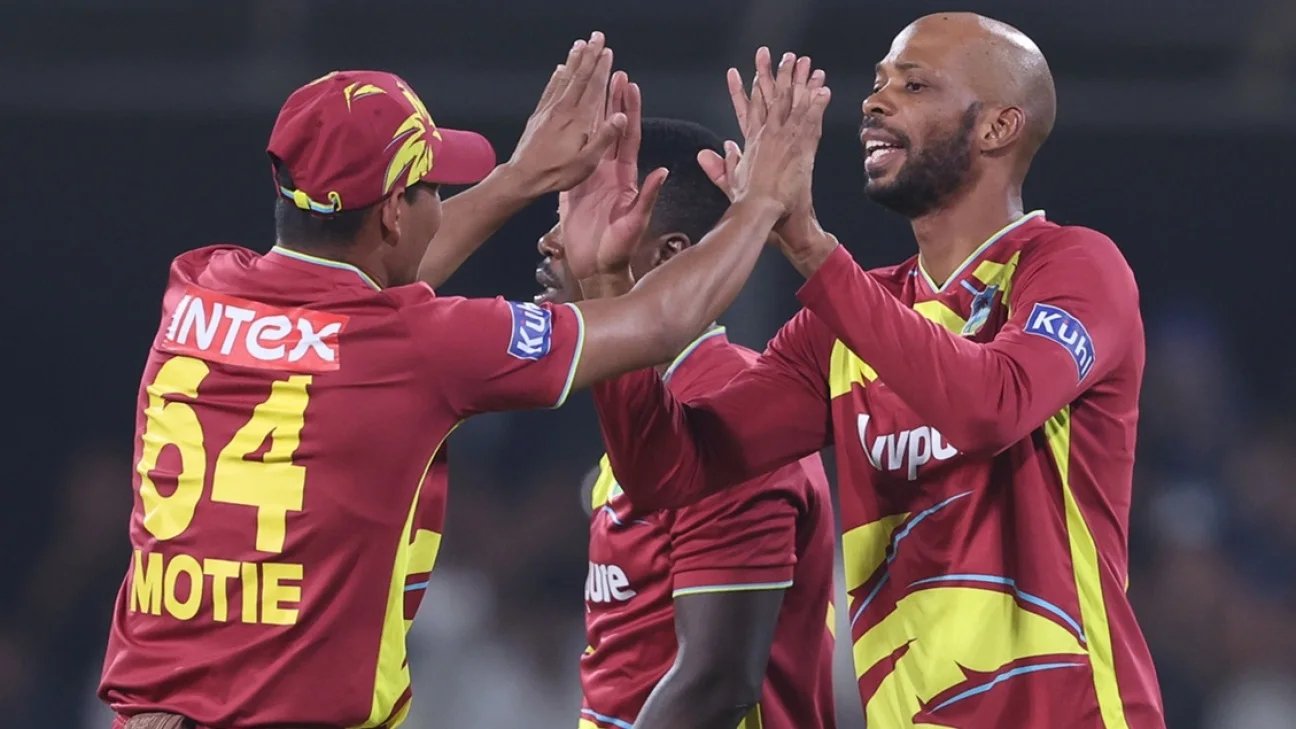
You play all three formats for West Indies. What adjustments do you have to make when switching between them?
The adjustment is about reading the game and the situation and deciding what is required at that time. That determines how I want to play. And the scoreboard always tells you what you need to do in any given situation. So that is how I go about altering my game for different formats.
You were recently playing in the CPL, where pitches tend to be on the slower side. In India, especially on this tour, the pitches have been really flat. As a bowler, what changes do you have to make?
There is not much of a big difference. The only difference is probably just the lines, because in the Caribbean, the ball might grip a bit more on the surfaces that are not as true and not as flat as in India.
So you may just have to adjust your lines a bit more. But the length remains the same. And you may have to vary the pace a little bit more. You might have to be a bit quicker, or a bit slower, depending on what the surface is giving you on a given day.
Talking about pace, we recently saw you bowling as quick as 111.6kph. Is that faster one a new addition to your bowling?
Not really. That’s a ball I always had. When I go for a yorker, I want to be as quick in the air as possible. I try to watch the batsman and not give him a full swing.
In terms of lines, you now seem to bowl a lot more from around the wicket to right-hand batters. What is the idea behind that?
I tend to vary it for different batsmen. If I think a batsman is a bit weaker on the leg-stump line, then I try to use that angle to restrict him as much as possible. And depending on how they set up and what their strengths and weaknesses are, you may need to keep the ball in front of them or in their blind spot. So, I look at different batsmen, look at their game – where they like to hit the ball and how their swing is – depending on that, I vary my angles.
Currently, it looks like your role also changes as per the format. In Test cricket, you are a batting allrounder, while in T20Is, you are a bowling allrounder.
Yeah, in this squad my role is clearly that of a bowling allrounder. But my role with the bat keeps changing. Sometimes I bat at No. 4, sometimes I bat at No. 8, sometimes I open the batting. So it varies depending on the line-up we have and what the coach thinks my best role is in that line-up. So it’s just about being clear with the coaches about what my role is.
I guess it just comes from wanting to contribute to the team and the team’s success. So I always try to go out there and do what is required of me to help the team, to take the team over the line. So it’s about going out there and having that mental capacity to do whatever it takes. I guess that’s what works for me.
In May 2025 you were named Test captain despite having not played a Test for two years. Were you expecting it?
Not really, I wasn’t expecting it. But when Sammy took over, he called me to have a chat about whether I would be willing to come back and play, despite not playing for the last two or three years. Red-ball cricket was always my first love. So, even though I wasn’t playing it and I was looking more into the white-ball arena, especially the Twenty20 stuff, I thought about it and accepted the challenge because I always wanted to go back. I didn’t know when I wanted to go back, but the opportunity presented itself and I took it.
So far, it has been a very challenging job, but I am enjoying it. This year, we reaped some rewards after not having the best of the years the year before.
CWI said that to appoint the captain, it used “a detailed assessment process that included psychometric testing to evaluate leadership style, behaviour, and overall suitability for the role”. What was the whole process like?
I had an interview with some of the members of the board and then we also had to do a written – I don’t want to call it an exam – but some test to do. We were allotted time to answer some questions that they sent to us by email.
What were those questions about?
It was a lot of different questions. I can’t exactly pinpoint – it was two years ago, but yeah, it was based on cricket, like what you would do in certain situations and what your leadership style is. So it was based around those kinds of questions.
And how would you describe your leadership style?
I would say my leadership style is one, it’s very calm. I can be a bit stubborn at times, but since I took the job, I have been listening to others a bit more. But I am not here to make everyone happy. I am here to make the best decisions for the team. I would have a chat with people but stick with what I think is the best idea.
Also, I try to encourage the players – it doesn’t matter whether we’re playing good cricket or bad cricket, winning or losing. At the end of the day, it’s my job to try to bring the best out of each and every player. So that’s my style – to uplift and encourage the players.
A lot of West Indies players prefer playing in T20 leagues around the world over red-ball cricket. You said at one stage, you were also more focused on T20 cricket. As a Test captain now, how do you deal with that situation?
You just work with the squad you are given. You can’t worry about who’s not here and who could have been here and who should be here. It’s about the guys who are in the squad. You have to work with them and try to give them that encouragement and the best opportunities to do well for the region.
Obviously, it’s not ideal. But it is what it is. The board has been crying out for some money, so they have to find a way to make ends meet. And they see that as the best way possible. Hopefully, we can play some good cricket, win some matches, get some money, get some sponsors on board and get people investing back into West Indies cricket.
It was a very important innings. We were under a bit of pressure after Sri Lanka made a big total [308], and we were like 150 [168] for 5. At that time, we needed a big partnership, and me and Amir Jangoo put on a record stand of 400 [401].
From a personal standpoint, too, it was very much needed. Because, as I said before, I did not have the best of the starts to my captaincy. The first year, we struggled. We had eight Test matches and we didn’t win anything.
There were obviously some tough Test matches against India, Australia and New Zealand, but when you are the captain, everyone is looking up to you to lead from the front, not only with words but also with performances. So to stand up and show the mettle, I thought it was perfect timing. It brought a lot of confidence back into the guys in believing in me, and in us as a unit as well.
In the past, you have spoken about wanting to become one of the top allrounders in the world. Where do you think you are in that pursuit?
In Twenty20 cricket, I’m still in the top 10 [No. 5 at the time of the interview]. Someday I want to become No. 1. But I think right now it might be a bit tough because I am playing as a bowling allrounder. So I only score points in terms of my bowling. Hopefully, I can work my way back to that No. 4 position that I had before. Once I get back there, hopefully I can turn up some runs for the team and win games. And with my bowling, too, help win matches. And then hopefully I can get to that No. 1 spot, and not only get there, but also stay there for a while.
Hemant Brar is a sub-editor at Cricinfo
