
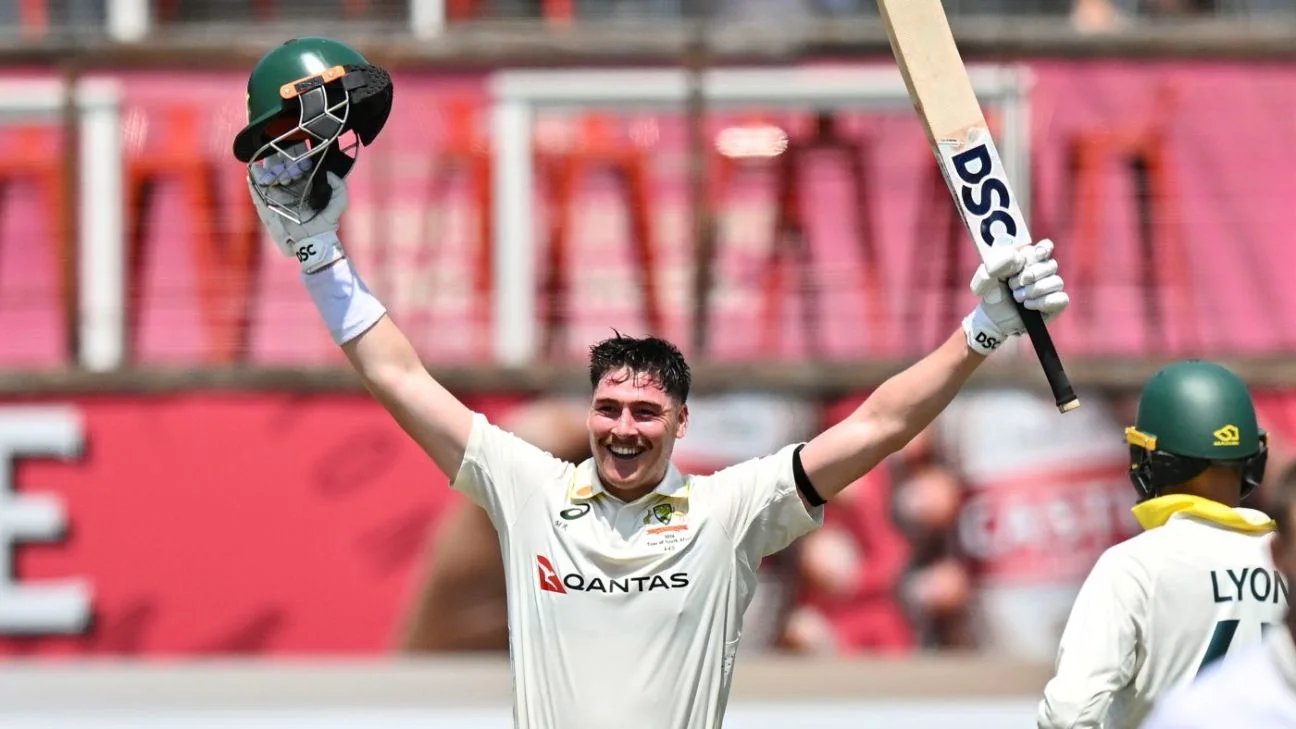
So far, it’s been a 50-50 success rate, and the contrast could hardly be wider. After Maddinson’s 33-ball duck, Renshaw walked in after lunch on the opening day and three balls later faced a scoreboard that read 84 for 4 when Steven Smith was worked over by Marco Jansen. Later in the afternoon it was 124 for 6.
“I always wanted that second one,” Renshaw said. “I had the monkey off the back early with that first one. I think it was like that all the stuff that has come in the last 10 years, all the hard work, all the failures, all the success. This was nice just for me to get.”
It was a magnificently constructed century, a display of a batter at ease with his game. Renshaw absorbed the early pressure when Australia were in trouble, leaving a high percentage of deliveries and, having negotiated the pace of Anrich Nortje when bad light ended play on the opening day, had just three boundaries from 115 balls. His fourth came from the second ball of the second day, when an edge with soft hands ran through the slips to take him to fifty.
He was there to face the second new ball – a switch back into his opening-batter avatar – and a little flurry of boundaries quickly brought the century in sight while he also protected Lyon from the strike in a masterclass of batting with the lower order. In one over against Nortje, there was a perfectly timed drive through the covers and an upper cut over the slips. Then, facing his 204th delivery, he whipped Nortje wide of mid-on with enough timing to reach the rope. The helmet came off, and the arms went aloft.
“I think once [I] took a few years out of the team, had an opportunity in 2023 and didn’t take it, you probably think that you’re never going to get this opportunity again,” Renshaw said. “So, yeah, when I hit the ball, I was screaming at it, ‘go, go, go’. It sort of all just hit me at once. You had Nathan at the other end, who was pretty emotional, so to see that, it was pretty special.”
“I knew I was at 96 and was just waiting for a ball that had my name on it. Fortunately, I got it pretty early. It was nice to get away from that pretty quickly and try and get back into it.”
And on he went, toying with South Africa’s spinners: Keshav Maharaj and Simon Harmer finished with combined figures off 1 for 143 from 48.2 overs, and just a single maiden between them, only breaking their duck when Harmer ended Renshaw’s epic with the second ball after tea. His game expanded as the innings went on. For a long time, there was not a single boundary in front of square, but by the end of his 465-minute stay was filled with a wide range of spokes including, late on, an upper cut for six to deep third.
It continued the unusual trajectory of Renshaw’s career which, in the last 12 months, has seen him emerge as a three-format player (taking a middle-order role in white-ball cricket) and forcing his way back into the Test side by his work as an opener in the Sheffield Shield for Queensland.
The only times he has not opened in first-class cricket since 2022 when he returned to the top of the order, firstly with Somerset then continuing it with Australia A and Queensland, are his three Tests in 2023, an outing for the Prime Minister’s XI in 2023 (when he scored a century against Pakistan) and now this match at Kingsmead.
It is clearly not the most unexpected stat, given they generally come in when the ball is a little older, but No. 5 provides the highest average of any position for Australia since November 2021, a cut-off picked as it corresponds with Travis Head’s return to the side for that season’s Ashes when he went on his thrilling run-scoring spree.
Narrowing the period down further, to the post-David Warner era which sparked the shuffling of Australia’s batting order, and it’s become even starker. Those at No. 5 average 48.52, with the next-best being No. 4 at 40.10. Renshaw became the sixth player to make a century from No. 5 since then; the top three has two players with centuries.
Green had been Australia’s standout batter against Bangladesh, making his first century at home in Darwin followed by an impressive 67 in Mackay. More evidence was needed that it was a true breakthrough, but the signs were promising and he was well-placed heading into this series. How long his absence extends remains to be seen, but when he does return, there is now another debate to have.
Does Renshaw move back to open, or is Beau Webster – whose last four Test innings read: 12, 5, 0 and 4 – now the player whose place is vulnerable? The other aspect is that even if Green is fit to play at some point in this series, he is unlikely to be able to bowl so Australia would lose an allrounder. But with plenty of part-time spin, they may be able to accommodate that on this tour, at least.
Still, those are questions to be answered in the coming weeks. For now, Australia have a Test to try to win, and Renshaw’s marathon has given them a position from which, at the very least, they can dictate terms.
Andrew McGlashan is a deputy editor at Cricinfo