
Walk past any major coaching hub in Kota, Hyderabad, or Namakkal on a Sunday morning, and you will witness huge crowds of teenagers rushing to do mock tests for JEE or NEET. They are drilled to solve mathematics, physics, and chemistry problems in seconds. Speed is everything. Pattern recognition is critical. Both are essential to win competitive tests.
But if you take a short detour into a quiet physics lab at the Homi Bhabha Centre for Science Education (HBCSE) in Mumbai, you will find a strikingly different scene. Here, a sixteen-year-old might be staring at a complex problem for three hours, sketching diagrams, conducting experiments, testing counterproofs, and discussing with a university professor over a subtle logical flaw in kinematics analysis.
This is the world of mathematics and science Olympiads. It’s a global battlefield where practised shortcuts and memorised formulae won’t take you anywhere.
While millions of Indian high schoolers fight for competitive ranks for engineering and medical seats through JEE and NEET, a much smaller but determined group sets its sights on the global stage. They represent India at international Olympiads in Mathematics, Physics, Chemistry, Biology, and Astronomy and Astrophysics. In these global competitions, the bright Indian students compete with thousands of students from over 110 countries such as China, the United States, South Korea, and Russia, and have been consistently winning medals and international acclaim for India for the last 26 years.
How the Olympiad is different from school board exams
The objective of the International Olympiad movement is to stimulate deep interest in mathematics and pure sciences among school students and bring the most talented ones together in a friendly competition of the highest level. While the Olympiads may not directly offer significant tangible benefits to the participating students, the problems that are posed provide a stimulus to look forward to higher studies in science or mathematics and embark on a lifelong, exciting career in the realms of intellectual challenges. International Olympiads are the meeting places of the brightest young minds of the world, and many friendships forged there form the seeds of scientific collaboration later in life.

A common misconception among parents and teachers is that Olympiad tests merely cover advanced topics for higher grades. In reality, unlike in schools, Olympiads test theoretical concepts as well as application through experiments in sciences. In mathematics, detailed proof is to be provided for every problem. Whereas the curricula of the Indian Boards focus on imparting prescribed subject knowledge, the Olympiads evaluate critical thinking and problem solving skills, deploying multi-disciplinary concepts and non-routine experiments.
How the national selection pipeline of excellence built
How does a student move from a school desk in Nasik or Coimbatore to an international Olympiad in Bath, Paris, or Dubai?
For pure sciences, the selection pipeline is managed by the Indian Association of Physics Teachers (IAPT) alongside the HBCSE, a unit of the Tata Institute of Fundamental Research (TIFR). The science Olympiad programme is fully funded by the Government of India.
Mathematics Olympiad is managed through a parallel academic track governed by HBCSE on behalf of the National Board for Higher Mathematics (NBHM).

Registrations can be done by students studying in classes 8 to 12 at recognised school centres through IAPT/HBCSE portals during August/ September. The national selection system acts as a five-stage filter designed to screen away test-prep shortcuts and select pure reasoning.
Stage 1: First level of screening is conducted through a 3 hour written test in October/November across hundreds of centres nationwide. The largest number of students (over 85,000) attempt the Indian Olympiad Qualifier in Mathematics (IOQM). In pure sciences, 30,000 to 50,000 students appear per subject for the National Standard Examinations (NSE).
Stage 2: National-level screening is done from the massive stage 1 pool, in January /February, and roughly 300 to 350 top performers are isolated per science subject to sit for the descriptive Indian National Olympiad (INO). About 900 to 1,000 top students make it to the Indian National Mathematical Olympiad (INMO).
Stage 3: Top 35 to 60 students are selected per discipline to attend the 2-3 weeks Orientation-cum-Selection Camp (OCSC) during April/May at HBCSE, wherein a rigorous residential training (theoretical lectures and advanced practical lab exams) is provided and candidates are evaluated on daily basis.
Stage 4 : Only four to six students per discipline make it to the national team. They receive advanced Pre-Departure Training (PDT) in specialised laboratories during July – September, before flying out to represent India on the world stage.
Stage 5: The international Olympiads are held generally during October – December period, for each subject in a different country.
During the 2025-26 cycle, about 2.56 lakh students registered for stage-1 exams from over 2,000 schools, an increase of 15% from 2023-24. Due to the stringent selection process at each stage, less than 0.01% from stage-1 registrants eventually earn a spot in the international squad. Compare it with the overall selection ratio of about 1.1% for B Tech at IITs !
Over the years, it was seen that a few schools stand out and consistently account for a disproportionately large share of qualifiers into stage-3. The common thread running across them is dedicated academic mentorship, coupled with problem-solving clubs. Top schools dedicate four to six hours a week during regular hours for proof-based mathematics and experimental design in sciences. Schools invest in advanced labs in physics and chemistry such as optics tables, analytical titration kits, and digital sensor setups so that students can practice long before reaching the HBCSE camps. Teachers spend weekends grading practical assignments, counselling the students and organising regional student seminars.
A proven track record of international success
In the last 26 years of participation, India has maintained an enviable record, with a whopping 99% of the contestants from India winning medals, with over a third of them gold.
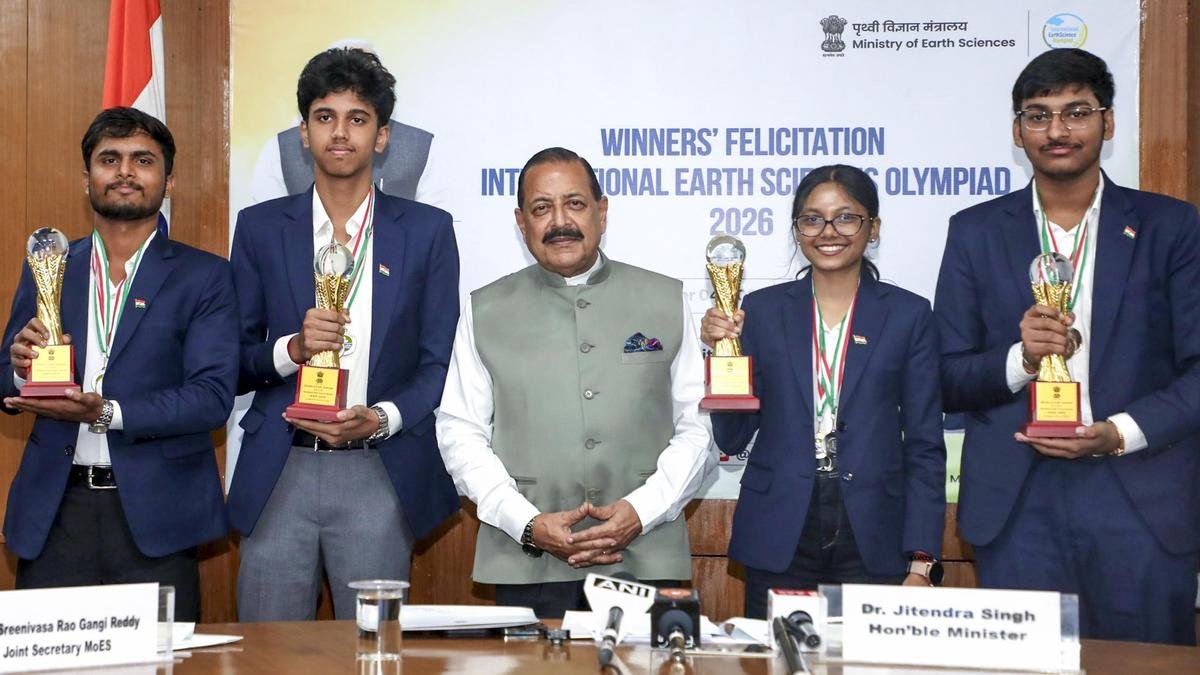
The 2026 international season was no exception. In Chemistry, India pulled off a historic 100% Gold sweep, competing against 93 countries, scoring joint first globally alongside China, Vietnam, and Russia. In Physics also, the team competed with 87 nations and earned five Gold medals, finishing joint 1st globally and maintaining India’s long-standing 100% medal record. In the International Mathematical Olympiad (IMO), where the competition is the toughest, the Indian delegation won two Gold and four Silver medals, ranking seventh globally out of 117 competing nations, with 652 contestants. In Biology, the four-student team earned one Gold and three Silver medals, achieving a 100% medal rate against 307 competitors from 78 countries. In Astronomy and Astrophysics, the 5-member team scored 3 gold and 2 silver, ending up with 3rd rank globally.
Mentoring role of premier research institutions
The key to India’s success isn’t test-prep software; it is hands-on mentorship from active scientists. Science in Indian schools is mostly theory-focused. Most school laboratories rarely let students move beyond the prescribed chemistry titration or simple pendulum experiments.
During the training camp at the HBCSE campus, high schoolers are thrown into experimental setups designed specifically to mirror international standards. The mentors leading these sessions aren’t commercial coaching tutors—they’re seasoned researchers and professors from institutions such as TIFR, IISc (Bengaluru), IITs, and IISERs.
A large number of secondary, higher secondary, and undergraduate teachers from all over India are involved in the national Olympiad programme. Several of them are invited to Resource Generation Camps (RGCs) at HBCSE throughout the year. Exposure camps are also organised at HBCSE to orient school teachers on the academic and organisational aspects of the Olympiads.
What makes this ecosystem sustainable is that former Olympiad medal winners —who went on to earn Ph.Ds from MIT, Cambridge, or Princeton—volunteer to return to Mumbai as mentors. They write test problems, grade papers late into the night, and coach students through the mental fatigue of multi-day international meets. It works.
Career track record of Indian medallists
Most IITs offer direct admission to B. Tech. to top performers, without requiring JEE. IIITs, IISERs, and ISI give preference and dedicated seat allocations to stage-2 and stage-3 Olympiad qualifiers. Globally reputed institutions like MIT, Harvard, Oxford, and the National University of Singapore give them more preference in admissions and scholarships.
In the past, several Olympiad winners pursued Ph.D. and chose academic and research careers. Today most of them are working as professors at reputed universities such as Chennai Mathematical Institute, IISc, IITs, MIT, Stanford, Princeton, and Cambridge and as researchers at frontier research institutions such as TIFR, Google, Open AI, Microsoft Research, Roswell Park Cancer Institute, U.S. Top quantitative trading firms such as Jane Street, Citadel, and Jump Trading actively recruit Olympiad medallists for their exceptional ability to analyse complex mathematical models under uncertainty.
Beyond university doors, the achievers of the Olympiads are recognised through government channels and prominent philanthropic organisations. The Infosys Foundation felicitates international medal winners and OCSC toppers with substantial financial awards, citation plaques, and lifelong research grants to support their higher education. Malhotra Weikfield foundation provides long-term fellowships for pursuing pure basic sciences in Indian universities. Innovation in Science Pursuit for Inspired Research (INSPIRE), sponsored by the Department of Science and Technology (DST), provides national science scholarships and research project grants throughout their undergraduate years.
Why early Olympiad training matters
Preparing for Olympiads early in school changes the approach of learning. Standard school board exams reward fast recall and memorised steps in exams. Olympiad problems train students to be perseverant and solve difficult problems without giving up.
For decades, India lost its sharpest scientific minds to corporate careers or foreign universities due to lack of motivation for basic research. When young Indian scholars stand on international podiums alongside peers from the U.S., China and Europe, it proves that India isn’t just an IT outsourcing hub. It shows the world that Indian talent can stand at the leading edge of mathematics and sciences.
Despite the consistent winning track record, the Olympiad ecosystem faces steep challenges. Awareness remains primarily in tier-1 cities and specialised schools. A bright student in a rural government school in remote India might never even hear about stage-1 exams.
Added to that is the relentless social pressure. Most parents push their talented children toward traditional entrance exams, viewing careers in pure science as risky and non-rewarding. To fix this, State boards need to introduce Olympiad-style problem-solving into everyday classrooms and conduct regional training camps so that talent in the non-metros can get fair opportunity.
As India expands its investments in quantum computing, space and defence tech, and green energy, pure science is no longer an option; it’s the basic foundation. The brilliant students representing India at international Olympiads aren’t just winning medals; they are demonstrating to us what happens when young minds are given the freedom to think out-of-the-box, experiment boldly, and solve tough problems. Mentorship and giving them an opportunity to demonstrate their ability in the international forum will make the difference in building the future Nobel Laurates in India for the world.
(Prof O R S Rao is the Chancellor of the ICFAI University, Sikkim. Views are personal)