
Historically, solving this equation meant packing bags for overseas institutions to secure a globally recognised postgraduate credential. But today, India’s rapid ascension as a global hub for technology, financial services, and entrepreneurship has flipped that narrative. The new paradigm allows high-achieving professionals to access world-class international education while remaining anchored in the domestic markets where the highest-growth opportunities are unfolding.
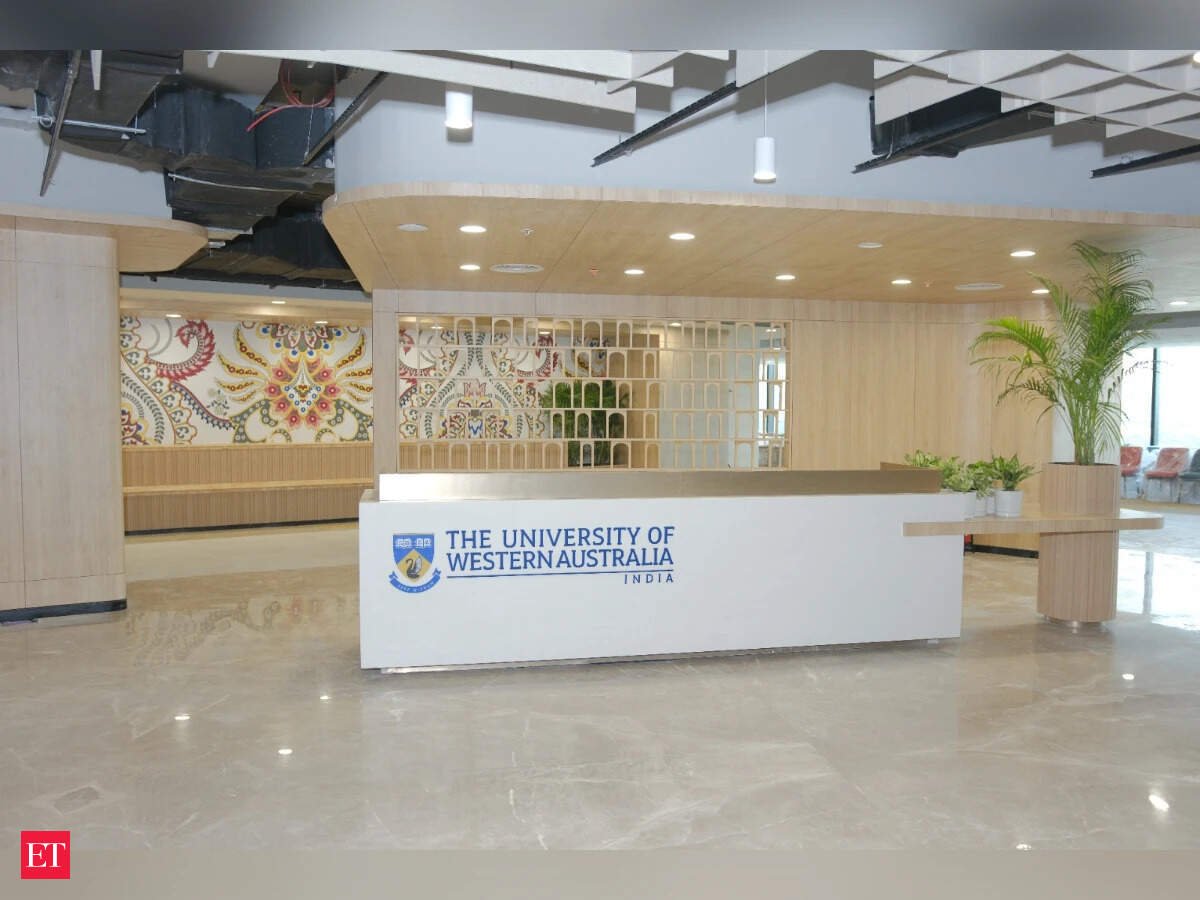
This convergence of global academia and local economic dynamism is precisely why the University of Western Australia (UWA), a World Top 100 university and founding member of Australia’s prestigious Group of Eight, has established its campuses in Mumbai and Chennai.
The choice of these two cities is deliberate. Mumbai and Chennai sit at the heart of two of India’s most important economic engines, possessing deep strengths across finance, technology, manufacturing, business, and innovation. UWA’s presence in these cities also builds on Western Australia’s longstanding economic, government, and industry relationships across India
 ET Spotlight
The result is a direct academic bridge linking two of India’s leading economic centres and Western Australia, the economic engine of Australia’s west, with its global strengths across resources, energy, technology, education, and innovation.

For postgraduate students, the proposition is straightforward: gain an internationally recognised UWA qualification, develop future-focused skills, and engage with industry ecosystems in India, without having to leave the country.At the core of this academic offering are the Master of Information Technology (MIT) and Master of Business Administration (MBA), designed for two groups central to India’s future workforce: technology professionals and the next generation of business leaders.
Building technology careers for an AI-led economy
Few commercial landscapes are evolving as exponentially as the technology sector. . Artificial intelligence, cloud computing, cybersecurity, data science and machine learning are transforming banking, healthcare, manufacturing, retail and adjacent verticals.
UWA India’s Master of Information Technology is engineered to equip practitioners with the multi-disciplinary dexterity required to navigate this digital frontier. Offered across Mumbai and Chennai, the rigorous two-year curriculum spans core and advanced domains including programming, cybersecurity, database systems, data science, software design, artificial intelligence, cloud computing, web development, machine learning, deep learning, high-performance computing, software testing and quality assurance, and computational modelling. Crucially, the syllabus embeds modules on project management and technological ethics, ensuring graduates can deploy innovations responsibly to solve complex enterprise challenges.
This breadth is no longer optional; modern technology roles are inherently cross-functional. Employers are looking for professionals who understand data and AI, but can also collaborate across functions, understand business requirements, and translate technology into practical outcomes. MIT framework empowers students to build a broad technology foundation while developing the ability to assess emerging technologies and apply IT methodologies to real-world challenges.
From professional expertise to business leadership
Technical prowess represents only one dimension of the modern workplace transformation. As businesses become more global, digital and data-driven, organisations also need leaders capable of navigating complexity, managing change and making decisions in uncertain environments.
UWA India’s Master of Business Administration directly targets this evolving executive landscape. The MBA is now open to both students joining the current cohort and fresh applicants. Available in Mumbai and Chennai, it offers an accelerated 12-month pathway covering accounting, economics, finance, marketing, organisational behaviour, international management, operations, entrepreneurship, project management, organisational change, and strategic management.
The value of an MBA today extends beyond individual business functions. Professionals need to connect disciplines and use data, strategy and judgement to make decisions. The program therefore develops analytical, strategic and leadership capabilities alongside functional business knowledge. For some, the objective may be career progression within an established organisation. For others, it could mean moving into management, transitioning into a new industry, pursuing entrepreneurship, or taking on broader strategic responsibilities.
Why Mumbai and Chennai matter
In executive education, geography is destiny. Mumbai is India’s financial and commercial capital, with a dense ecosystem of banks, financial institutions, multinational corporations, startups and entrepreneurial ventures. UWA’s Mumbai campus in Andheri places students within this wider business ecosystem, with access to major transport links and corporate centres. Chennai offers a complementary proposition. As a major centre for education, manufacturing, technology and industry, the city provides exposure to sectors driving India’s next phase of economic growth.
The selection of both cities reflects UWA’s broader connection with India and Western Australia. Western Australia has longstanding relationships with India across government, trade, resources, energy, education and industry. Establishing a permanent UWA presence in Mumbai and Chennai builds on these connections while placing students within two of India’s most dynamic economic environments.
It also creates a natural bridge between the opportunities of India and Western Australia—two markets with significant strengths in technology, innovation, industry and future-focused skills. UWA India’s campuses are designed around this philosophy, with technology-enabled classrooms, innovation and project labs, group-work studios, student hubs, and collaboration spaces supporting an interactive learning experience.
Education that extends beyond the classroom
The true metric of a postgraduate qualification lies in execution—how effectively theoretical frameworks translate into operational impact. UWA India’s postgraduate offering incorporates career-focused support, including career advisors and coaching, CV and interview preparation, industry mentoring, internship opportunities, and networking with employers.
Beyond the lecture halls, students participate in high-impact hackathons, innovation challenges, leadership activities, clubs, societies, and other collaborative experiences. This reflects a broader shift in what employers expect from graduates. Technical knowledge and academic credentials remain important, but employers increasingly value the ability to solve problems, communicate, collaborate, adapt and apply knowledge in unfamiliar situations.
ET SpotlightA global degree, without leaving India
The arrival of UWA’s postgraduate infrastructure in Mumbai and Chennai signals a structural maturation of international education in India. Ambitious talent no longer needs to cross oceans to access world-class academic rigor; elite international qualifications are now accessible natively within India’s expanding professional corridors. .
With a global alumni network of more than 150,000 graduates and UWA’s international academic and industry connections, the India campuses are intended to provide students with both local relevance and a global perspective.
For a technology graduate preparing for an AI-driven economy, the Master of Information Technology offers a pathway to build capabilities across the digital spectrum. For professionals ready to move from expertise into management and leadership, the MBA provides a focused route to develop strategic and business capabilities.
With the MBA now open to both the current cohort and fresh applicants, aspiring business leaders have the opportunity to begin their journey now, whether they are already part of UWA India’s student community or considering postgraduate study for the first time. Both programs represent a broader idea: global ambition does not necessarily require global relocation.
With admissions for the MBA now open to fresh applicants alongside current candidates, aspiring leaders have an immediate window to initiate their transformation. Ultimately, these programs validate a defining premise of the modern economy: global ambition no longer demands global relocation. For the next generation of innovators, strategists, and executives, the journey to Learn Here, Lead Everywhere begins right here in Mumbai and Chennai.
Disclaimer: This article has been produced on behalf of University of Western Australia India by Times Internet’s Spotlight team.
