
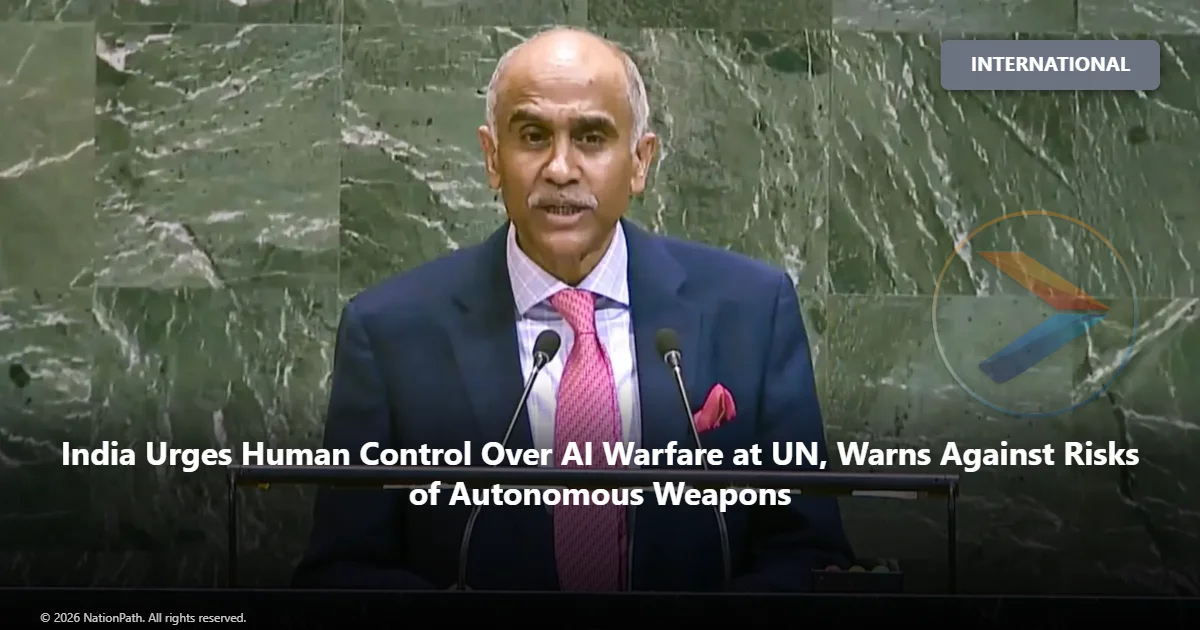
India has urged the international community to ensure that artificial intelligence (AI) and other emerging technologies remain under meaningful human oversight when used in military and conflict situations. The country warned that increasingly sophisticated autonomous systems could introduce significant legal, ethical and security risks if technological capabilities advance without adequate human judgement and accountability.
India’s position was presented by Ambassador Harish Parvathaneni, Permanent Representative of India to the United Nations, during a high-level open debate of the UN Security Council on November 24. The meeting, convened under Latvia’s presidency, focused on the theme “Conflict Resolution in an Era of Rapid Technological Change”.
Addressing the Council, Parvathaneni highlighted how artificial intelligence, autonomous systems and emerging digital technologies are transforming military operations, intelligence activities and the broader international security environment.
He emphasised that technology should remain a tool serving human-directed objectives rather than becoming an independent authority over decisions involving human lives.
India particularly stressed the importance of maintaining human judgement and oversight in the deployment of autonomous weapons systems. The ambassador said responsibility for the use of such systems must always remain with humans, taking into account the operational circumstances and characteristics of individual weapons.
The issue is especially significant as military technologies increasingly incorporate automated capabilities that can assist in identifying, selecting and engaging targets. Such developments raise questions about accountability, civilian protection and compliance with international humanitarian law.
India reiterated its commitment to addressing concerns surrounding lethal autonomous weapons systems within the framework of the Convention on Certain Conventional Weapons (CCW), an international agreement that provides a platform for discussing restrictions on specific conventional weapons.
The Indian representative also identified the potential misuse of artificial intelligence by terrorist organisations and non-state actors as a serious concern. He warned that incomplete, inaccurate or deliberately manipulated information processed through AI systems could undermine decision-making and create additional security vulnerabilities.
Beyond military applications, India highlighted the potential benefits of emerging technologies in conflict prevention and humanitarian operations. AI-powered analytical tools, satellite imagery and digital platforms can strengthen early-warning mechanisms, improve situational awareness, support mediation and help the United Nations respond more effectively to emerging crises.
Parvathaneni also raised concerns about technological inequality between developed nations and countries of the Global South. He argued that developing countries should not remain merely consumers of advanced technologies but should have meaningful participation in decisions concerning their development, regulation and deployment.
India further highlighted the possibility that AI systems could reproduce existing social biases, including those related to gender, language and socioeconomic backgrounds.
The ambassador called for inclusive international cooperation that balances technological innovation with national priorities, human dignity and international security.