
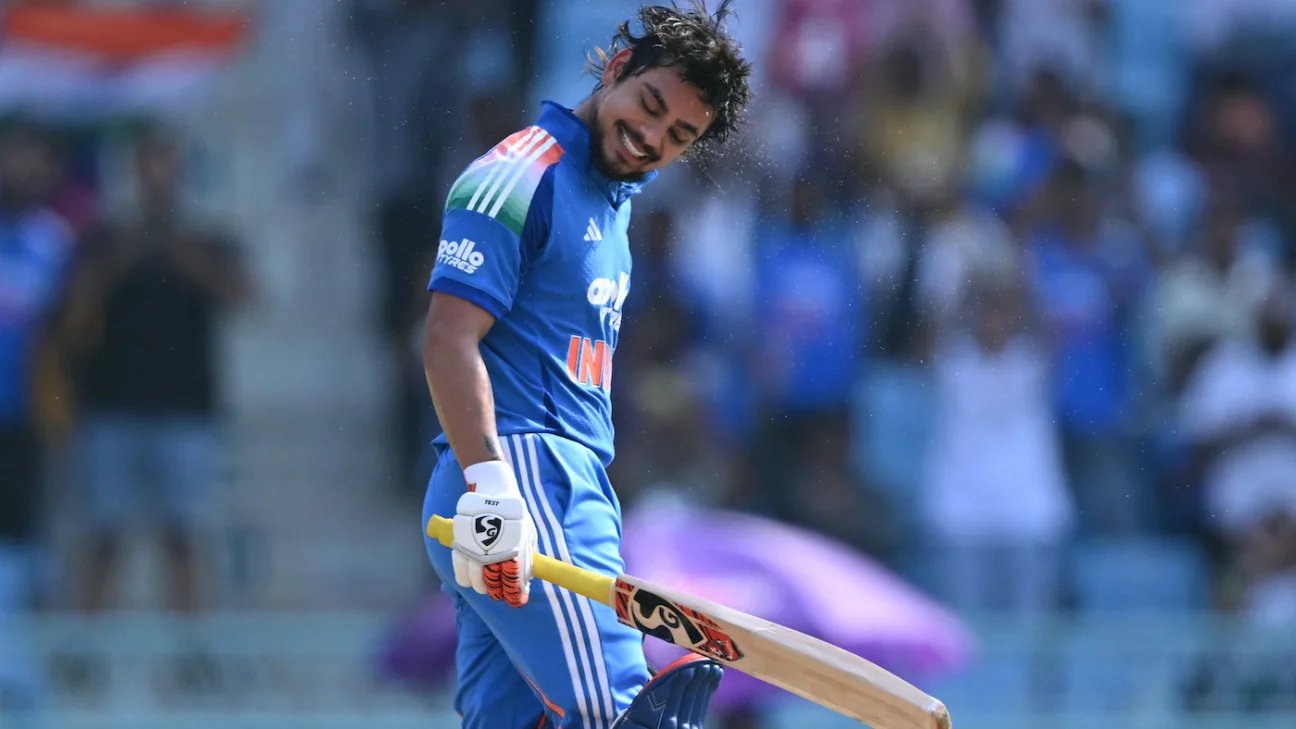
The car stopped at the porch of the administrative block. Standing right at the gate, leaning on a walking stick in a guard’s uniform, was an elderly man, Subhash Singh, who has been a silent witness to every changing season at this ground for nearly a decade. There was no stardom around Kishan. He walked to Subhash and very affectionately asked about his well-being.
A person standing nearby later jokingly asked Subhash, “Do you recognise him?”
With a smile, Subhash said, “Pehchanenge, nahi sahab? Apna Kishan hai. Jabse yahan duty kar rahe hain isko aise hi dekhte aaye hain. Bahut achha ladka hai. Izzat dene mein bhi koi kami nahi chhodta (Won’t I recognise him? He’s our Kishan. I’ve seen him just like this ever since I’ve been on duty here. He’s a very good boy, he always shows great respect.”
The player who was once dropped across formats from international cricket, who lost his central contract, and was being labelled as “careless,” not only returns as a T20 World Cup winner, but does it by connecting with his roots.
After meeting Subhash, Kishan crossed the dressing room corridor and stood near the indoor nets. This is the very place that gave refuge to that 14-year-old boy in 2012 when Bihar cricket was embroiled in problems.
Such was the state of Bihar cricket at the time that charting a pathway to top-level cricket was far from straightforward. This lean teenager emerged from Kankarbagh in Patna to the SAIL (Steel Authority of India Limited) quarters. There he was with four senior players and would cook rice and lentils on his own after returning from the nets at night and would sometimes have just biscuits for dinner. His elder brother at home, Raj Kishan, was also an aspiring cricketer but he left the game and focused on education to support their financially constrained father so Ishan would never leave for the ground without a new pair of gloves.
Kishan is the product of that penance. It led to a first-class debut against Assam in 2014, captaining the Under-19 World Cup under Rahul Dravid’s supervision in 2016, and then knocking on the doors of the national team via the IPL, culminating in an India debut in 2021.
However, international cricket can turn you into a poster boy overnight and then ground you the next day. Withdrawing from the South Africa tour in December 2023 citing mental fatigue, Kishan skipped domestic cricket and eventually lost his central contract. Kishan doesn’t hide the struggles of that time.
“When I was dropped from the international team, I realised the consequences of some of my mistakes,” Kishan told JioStar. “I worked on my fitness and batting. I was patient and focused on improving my flaws by doing well in domestic cricket. I knew that if I kept scoring runs consistently in domestic cricket, an opportunity would definitely come, and this comeback is earned through my own hard work. My job is just to keep scoring runs, the rest of the things fall into place automatically.”
Kishan, at that time, switched off his phone, cut himself off from the world and headed to the JSCA Stadium. He gathered his old Jharkhand friends – Saurabh Tiwary, Ishank Jaggi, and Jharkhand coach Ratan Kumar among them. No one was around him, no camera clicks, just the sound of the ball hitting his bat and his drills.
“The best thing about tomorrow’s match [against West Indies] will be watching Kishan play,” Tiwary says. “Many stories of his comeback can be written around it. The way he met us during his bad times, I knew in that moment that this boy was in the mood to do something different. During Syed Mushtaq Ali Trophy (when he was captain), the kind of vision he had while talking about player selection, their needs, and field strategies was amazing. Now that he is returning after winning multiple trophies, this is an incredible experience for me too.”
When Kishan took over as Jharkhand captain in SMAT, he changed the mood of the entire team. While putting together what turned out to be a title-winning team in domestic T20s, Kishan was in constant touch with then coach Manoj Yadav, who had also witnessed the early stages of Kishan’s career closely.
“Mahendra Singh Dhoni put Jharkhand on the cricketing map,” Manoj says. “After him, many players took the state’s name forward, but Kishan not only worked on his game but also built a team that has been etched in Jharkhand’s cricket history. Kishan has had a big role in the way every player has clarity in the team and in how youngsters are making a name for themselves in the country.”
While Kishan’s behind-the-scenes planning was taking shape off the field, his runs had returned on the field. In the title-winning SMAT campaign, he topped the run-scoring charts with 517 for an average of over 57 and a strike rate of 197.
Kishan was soon back in the Indian T20I team as an aggressive top-order batter. This year alone he has racked up 1042 runs – the most so far – in T20Is, to average over 38 with a strike rate of 168.06, with a century and seven half-centuries. The peak of his achievements was the T20 World Cup.
That was soon followed by call-ups for the ODI squad and the Duleep Trophy, where he led East Zone to the title, and in September Kishan also had the Asian Games gold medal around his neck.
The light was fading on Wednesday evening when he returned towards the JSCA administrative block after having a look at the pitch. But when he steps out to play against West Indies on Friday evening, all the camera flashes and lights of the cricketing world will be back on him.
राजन राज Cricinfo हिंदी में सब एडिटर हैं