
From import dependence to self-reliance
India is the world’s largest producer of pulses ; pulses are important and protein-rich food crops worldwide. Pulses contain 20-25% protein , more than twice that of wheat and nearly three times that of rice. Pulses play a significant role in India’s agricultural exports and remain an essential part of the Indian diet , ensuring nutritional security. Recognizing this importance , the government launched the ” Mission for Self-Reliance in Pulses ” on October 11 , 2025. As the nation celebrates the first anniversary of the launch of this mission on October 11 , this important initiative is progressing rapidly. A financial allocation of ₹ 11,440 crore has been allocated for this mission from 2025–26 to 2030–31. The mission aims to achieve self-sufficiency in pulses production . It focuses on promoting domestic production , reducing dependence on imports and increasing farmers’ income through a comprehensive value-chain approach .
A mission with a clear goal
Under this mission , production is expected to reach approximately 35 million tonnes and yields per hectare to increase to 1,130 kilograms by 2030-31 . Key strategic measures to help achieve these goals are:
- Focus on increasing the production of Tur (Pigeon pea) , Black gram and lentil
- Promoting climate-resilient seeds and improved seed quality
- Distribution of 87.5 lakh free seed kits and 126 lakh quintals of certified seeds in six years
- To increase the area under pulses cultivation by 35 lakh hectares to reach the total target of 310 lakh hectares by 2030-31 .
- Cluster-based approach covering 489 districts to increase production
- Establishment of 1,000 processing units (dal mills)
- Assured procurement of Tur , Urad and Masoor from willing and registered farmers through NCCF and NAFED
- Expected to reduce dependence on imports and save foreign exchange
India’s major pulse production center
India’s pulses sector recorded strong growth in domestic production , cultivated area , and crop yield during 2025-26 . Continued agricultural progress and strong local production are strengthening the country’s pulse economy.
- India’s total pulses production is expected to increase from 256.83 lakh tonnes in 2024-25 to 274.09 lakh tonnes in 2025-26 (3rd Advance Estimate).
- The area under pulses cultivation in India increased from 277.20 lakh hectares in 2024-25 to 286.46 lakh hectares in 2025-26 .
- The major pulses producing areas are Madhya Pradesh , Maharashtra , Rajasthan , Uttar Pradesh , Gujarat , Andhra Pradesh , Karnataka , Jharkhand , Odisha and West Bengal.
- Pulse productivity improved at the national level , with total yield increasing from 926 kg per hectare in 2024-25 to 957 kg per hectare in 2025-26 .
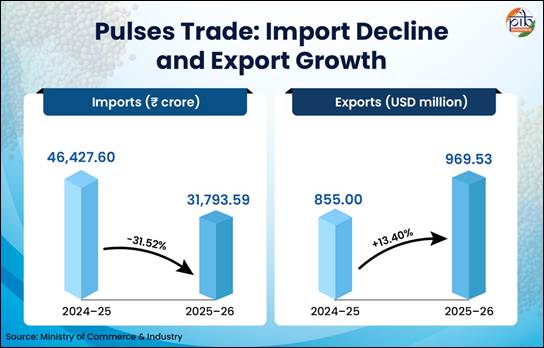
- India’s pulses imports are expected to decline by 31.52% from Rs 46,427.60 crore in 2024-25 to Rs 31,793.59 crore in 2025-26 .
- Pulse exports from India are projected to increase by 13.40% from US$ 855 million in 2024-25 to US$ 969.53 million in 2025-26 . Total exports during 2025-26 will reach 10.01 lakh tonnes.
- In 2025-26 , the major countries of exports included China , United Arab Emirates , Bangladesh , USA and Sri Lanka .
Increase in Minimum Support Price (MSP) and assured procurement
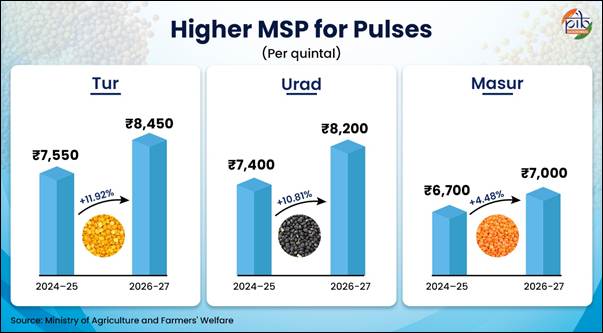
The government is continuously strengthening price protection for pulse farmers by substantially increasing minimum support prices (MSPs). These increases ensure fair prices for farmers and boost domestic production of staple pulse crops.
- The Minimum Support Price (MSP) of Urad was fixed at Rs 7,400 per quintal for the marketing season 2024-25 , which was increased by Rs 800 ( 10.81%) to Rs 8,200 per quintal for 2026-27 .
- The MSP of Tur (Arhar) for the year 2024-25 was Rs 7,550 per quintal , which increased by Rs 900 ( 11.92%) to reach Rs 8,450 per quintal in 2026-27 .
- The MSP of lentils was fixed at Rs 6,700 per quintal for the year 2024-25 , which was increased by Rs 300 ( 4.48%) to Rs 7,000 per quintal for 2026-27 .
Under the Mission , National Cooperative Consumer Federation of India Limited (NCCF) and National Agricultural Cooperative Marketing Federation of India Limited (NAFED) have been authorized to procure 100% of Tur , Masoor and Urad for a period of four years ( 2025-26 to 2028-29) . As of June 17, 2026 , the key achievements from the NCCF Pulses Procurement Dashboard are as follows:
- NCCF procured a total of 10.55 lakh tonnes of pulses across nine states . Minimum Support Price (MSP) payments worth a total of ₹ 7,047 crore were released directly to farmers. This initiative benefited 4.69 lakh farmers out of a total of 7.74 lakh registered farmers.
- Under Kharif 2025-26 , 7.89 lakh tonnes of pulses worth Rs 6,431 crore were procured , benefiting 3.66 lakh farmers .
- Under Rabi 2026-27 , procurement of pulses reached 23.51 lakh tonnes , under which MSP of Rs 14,217 crore was released and 10.20 lakh farmers were benefited.
- Procurement of pulses increased from 18,39,504.77 tonnes in 2024-25 to 31,40,883.92 tonnes in 2025-26 .
Early major progress of the mission
The Mission’s initial progress demonstrates continued progress in building infrastructure and supporting farmers. Key achievements so far include:
- The mission plans to set up 1,000 pulses processing units , of which 528 units have already been allocated to states and union territories in the first phase .
- A total of 23 pulses processing units have been approved for Creation and Expansion of Food Processing and Preservation Capacities (CEFPPC) under the Pradhan Mantri Kisan Sampada Yojana (PMKSY) . Out of these approved infrastructure projects, work on 18 pulses processing units has been successfully completed.
- To promote cultivation of pulses after paddy harvest , the mission aims to distribute 87.5 lakh seed kits in six years , out of which 9.25 lakh kits have been distributed during Rabi 2025-26 .
Digital monitoring and seed traceability
The Government uses advanced digital platforms to ensure seamless monitoring , real-time inspection and targeted implementation at all levels:
- A three-tier steering committee network has been created for planning , implementation and monitoring of progress at the national , state and district levels .
- The ‘ Krishi Mapper ‘ application enables accurate geo-fencing , geo-tagging of land and real-time monitoring of seed variety performance and yield .
- The ” SAATHI ” ( Seed Authentication , Traceability and Holistic Inventory) portal provides a holistic approach covering the entire seed lifecycle. This solution is achieved through the automation of the seed supply chain , from seed production to certification and seed sales.
- Agristack and Digital Crop Survey: Combines unified farmer ID with soil health card analysis and verified plot surveys to ensure targeted nutrient delivery and accurate crop forecasting.
- Verification platforms like ‘ e-Samriddhi ‘ and ‘ Vistaar ‘ ensure direct payments , real-time market data and domestic price stability.
Sowing today , protecting tomorrow
Early trends suggest that the ‘ Self-Reliance Mission ‘ in pulses is successfully balancing policy intent and implementation on the ground. Guaranteed price support has restored producer confidence , while digital platforms like ‘ Saathi ‘ and ‘ e-Samriddhi ‘ ensure complete transparency across the entire supply chain. As India moves towards its target of 35 million tonnes of pulses production by 2030-31 , this integrated value-chain framework not only promises long-term national protein security and foreign exchange savings , but also offers an exemplary model for self-reliance across the broader agricultural sector.
Reference
Ministry of Agriculture and Farmers Welfare
https://www.pib.gov.in/PressReleasePage.aspx?PRID=2177847®=48&lang=2
https://www.pib.gov.in/PressReleasePage.aspx?PRID=2284230®=48&lang=1
https://upag.gov.in/dash-reports/progressivecropareasown
https://pulsesmission.da.gov.in/pulseswebinar.aspx
https://www.pib.gov.in/PressReleasePage.aspx?PRID=2239790®=48&lang=2
