
The spinning wheel in a village was once a symbol of nationalism. Today , that same spirit is taking new shape through a growing ecosystem of rural enterprises. Honey , herbal products , banana fiber , textiles, and other village industries are creating new possibilities for traditional skills.
This spirit of self-reliance continues to resonate with the vision of Vocal for Local and Atmanirbhar Bharat . Traditional skills and local resources are finding new markets through access to finance , technology, and training.
This growing connection between local businesses and consumers is also reflected in the Khadi Festival, which is held annually from October 2nd to October 31st . This campaign, specifically aimed at youth, creates awareness about Khadi and the “Vocal for Local” movement, and encourages the general public to purchase Khadi and local products.
At the heart of this transformation is the Khadi and Village Industries Commission ( KVIC) . It is a statutory body established under the Khadi and Village Industries Commission Act , 1956. This Act empowers KVIC to plan , promote , facilitate , organize, and support village industries. This includes measures related to training , raw materials , marketing , research, and quality improvement. It provides technical information and facilities related to Khadi and Village Industries, as well as supports skill development and research.
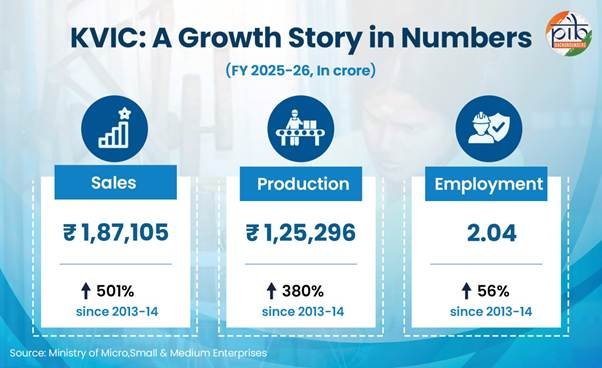
In 2025–26 , sales of Khadi and Village Industries products will reach a historic ₹ 1.87 lakh crore , the highest ever (as of May 2026 ). Sales increased by 501% compared to 2013–14 , while production increased by 380% to ₹ 1,25,296 crore . Employment in the sector increased by 56% to 20.4 million. Remuneration for artisans has also increased, from ₹ 4 per lachhi in 2013–14 to ₹ 15 per lachhi at present , an increase of approximately 275% .
One hanchi is equal to 840 yards of yarn in length and one pound in weight.
Building rural businesses, one artisan at a time
From skill learning to market access , artisans and village industries are being supported through various initiatives.
KVIC has a network of 35 departmental and non-departmental training centers. Training includes food products , bakery , beekeeping , incense sticks , candles , motor repair, and many other activities. During the fiscal year 2025-26 , 79,682 trainees received training under various KVIC training programs.
Of the nearly five lakh artisans in the Khadi sector, more than 80% are women. In 2025–26 , 47,382 women received training under various KVIC programmes , accounting for about 59% of the total trainees .
Along with training, distribution of toolkits and equipment , marketing support and other measures are also being taken.
Since March 2008 , the Prime Minister’s Employment Generation Programme ( PMEGP) has provided employment opportunities to about 97.95 lakh people through KVIC
One such beneficiary is Mr. Jitendra Baitha , who established a bakery product manufacturing unit in Bihar in 2020. His enterprise has an annual turnover of ₹ 7.2 million and currently employs 20 people from the local community. The assistance also includes venture financing and the necessary equipment and technology for production.
The Village Industries Development Scheme empowers artisans by providing modern machinery , toolkits, and equipment. During 2025–26, 37,769 such machinery , toolkits, and equipment were distributed. KVIC has so far distributed over 3.23 lakh machinery , toolkits, and equipment under this scheme (as of May 2026 ).
These efforts are also strengthened by measures that strengthen the broader ecosystem in which Khadi institutions and artisans operate.
The Khadi Vikas Yojana helps Khadi institutions improve products , enhance value, and adapt to changing market demands. Its Modified Market Development Assistance ( MMDA) provides greater flexibility for value addition and market-oriented pricing. During 2024–25 , ₹ 245 crore was disbursed to 1,097 Khadi institutions , benefiting 145,484 artisans.
The availability of affordable loans adds another layer of support. Under the Interest Subsidy Eligibility Certificate ( ISEC) scheme, eligible Khadi institutions can obtain loans at a concessional interest rate of 4% per annum.
The work environment also matters to artisans. The Workshed Scheme provides better production spaces and a more conducive work environment. During the year 2025–26 , as of December 2025 , 1,309 artisans benefited under this scheme .
These measures support artisans by providing them with better working conditions and access to the resources needed for production.
From rural enterprises to wider markets
Traditional skills and local resources in various village industries are being transformed into new businesses and products through technology , training, and market linkages. Research and development efforts are strengthening productivity , quality, and competitiveness.
Mr. S.P. Singh established a honey and cookies enterprise with support from KVIC under the PMEGP scheme. His Punjab-based business now employs approximately 200 workers and exports its products to international markets. Honey and cookies are among his major products , with a significant portion of exports going to the United States.
After receiving assistance in 2010 , the enterprise gradually expanded its export presence by participating in international exhibitions. KVIC facilitated participation in exhibitions in Dubai , the United States, and the Middle East , helping the enterprise connect with foreign buyers. Today, the business exports to 36 countries and is developing a second unit in Rajpura , Punjab, to expand honey exports to European markets.
For Mr. B. Sundarraj, a natural aromatic plant became the foundation of a rural enterprise. Through his incense stick unit, he produces incense sticks , herbal products , vetiver (khus) incense sticks, and vetiver sambrani. With support under the Village Industries Development Scheme ( GVY) during the year 2024-25 , he strengthened his manufacturing capabilities and diversified his product range. This enabled him to create several value-added products from locally available resources. His enterprise demonstrates how KVIC support can help transform traditional knowledge and local resources into marketable village industry products.
Mr. Sahil Chaudhary runs a mono-carton manufacturing unit in Jatti Majra village, Solan district , Himachal Pradesh . This enterprise caters to the manufacturing and packaging needs of the region. Established with a project cost of ₹ 25 lakh, the unit operates under the KVIC- supported PMEGP .
The enterprise now registers an annual turnover of approximately ₹ 4.5 million and employs 23 people. Financial support helped transform Chaudhary’s entrepreneurial idea into a viable manufacturing enterprise. His journey demonstrates how local entrepreneurship can contribute to self-reliance , employment, and the broader vision of a self-reliant India.
Opening up new markets for rural enterprises
KVIC has expanded both digital and physical channels to reach consumers. It has an online Khadi India Store ( www.khadiindia.gov.in ) that offers a wide range of products, including clothing , textiles , groceries , beauty products , essential oils , perfumes, and incense sticks.
The Khadi India brand is supported through dedicated promotional and marketing initiatives. These efforts connect traditional products with modern consumers. Its marketing network spans the country, consisting of eight departmental Khadi India sales centers and 15 KVIC branches. Khadi institutions operate another 8,035 sales centers across the country.
National , regional , state, and district-level exhibitions provide additional market opportunities. KVIC also promotes participation in domestic and international trade fairs.
Khadi: Weaving a Global Story
Khadi is finding new forms in the fashion world , and its distinctive craftsmanship has been showcased at platforms such as New Zealand Fashion Week 2026 and Lakme Fashion Week 2025. These events combined traditional techniques with contemporary designs to create a distinct modern identity.
From legacy to opportunity
The growth of Khadi and Village Industries is reflected in increased production and sales , expanded employment , increased wages for artisans, and new rural businesses. As traditional skills are integrated with technology , finance, and markets , the sector is opening up new avenues of enterprise across rural India.
