
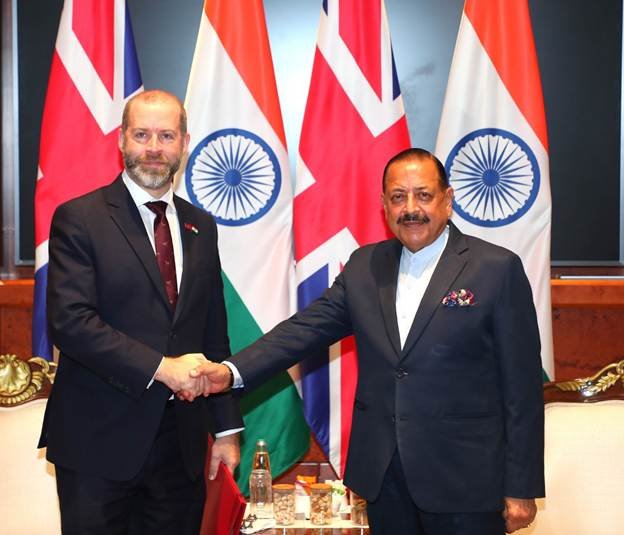
India and the UK have emphasized strengthening bilateral cooperation in the fields of space, civil nuclear energy, scientific research and emerging technologies. Dr. Jitendra Singh, Minister of State (Independent Charge) for Science and Technology, held bilateral talks with Jonathan Reynolds, UK Minister of State for Business, Innovation, Science and Trade. The meeting covered a range of important topics, including small modular reactors, clean energy technologies, startups, artificial intelligence (AI), quantum technology and medical research. Both sides emphasized leveraging scientific capabilities to explore new opportunities for research, innovation and business collaboration.
Emphasis on increasing cooperation in the space sector
Dr. Jitendra Singh said that reforms in India’s space sector have opened up new opportunities for private companies, startups, and technology developers. This has allowed established research institutions to focus more on advanced research and technology development. He said that India and the UK can expand cooperation in this area by enhancing research partnerships, technology development, investment, and industry participation.
Initiative to leverage the experience of 800 space startups
The meeting discussed cooperation in the fields of space science, satellite development, and research, as well as greater collaboration between scientific institutions and technology companies from both countries. Noting the presence of approximately 800 space technology startups in India, Dr. Jitendra Singh proposed increasing engagement between Indian and British startups and small companies. This could help foster innovation, strengthen supply chains, and expand business opportunities.
Discussion on civilian nuclear energy and small modular reactors
In the field of civil nuclear energy, Dr. Jitendra Singh briefed India on the reforms underway and the opportunities being created for broader participation in nuclear energy development. He also mentioned the “Sustainable Use of Nuclear Energy for India’s Transformation and Development (Peace) Act, 2025.” The meeting discussed possibilities for cooperation in small modular reactors (SMRs), advanced nuclear technologies, and related industrial capabilities. The importance of these technologies in the context of growing energy needs, industrial development, electrification, and the increasing power demand from data centers was also considered.
Potential for partnership in nuclear medicine and health research
Dr. Jitendra Singh highlighted the other uses of India’s nuclear program beyond power generation, particularly its contribution to nuclear medicine and healthcare. He highlighted India’s activities in radioisotope and cancer research, emphasizing the potential for collaboration with UK expertise in life sciences and medical research. Historical scientific collaboration between the two countries in the field of tropical diseases was also cited as an important basis for expanding biomedical research.
Discussions on AI, Quantum Technology and Cyber Security
The talks also discussed emerging areas such as artificial intelligence, quantum technology, cyber-physical systems, and cybersecurity. Dr. Jitendra Singh stated that AI will play a crucial role in future development and that its effective use is essential to maximize its benefits. He noted India’s interest in developing small-scale AI models tailored to local needs and available resources. Both sides also discussed the practical use of new technologies, managing their associated risks, and the need to strengthen cybersecurity to protect critical systems.
Collaboration opportunities in quantum research and advanced sensors
The two countries discussed the possibilities of cooperation in quantum technology, advanced sensors, gravimetry, and space-based geospatial applications. The need for joint research and development of new applications through the integration of space science and emerging technologies was emphasized. Improved interaction between scientific institutions, experts, and industry was considered crucial for translating research capabilities into practical results.
UK supports research and business partnerships
UK Secretary Jonathan Reynolds welcomed the growing engagement between the two countries. He emphasized the potential for regular dialogue between institutions, research and innovation partnerships, and business collaboration. Referring to the UK’s space strategy, he expressed interest in furthering cooperation in the field of civil nuclear energy for peaceful purposes. He also welcomed the potential for India-UK partnerships to enhance technological innovation and productivity, citing AI as a priority for the UK’s upcoming G20 presidency.
Towards strengthening partnerships in strategic technology areas
The Indian delegation at the meeting was led by Dr. Jitendra Singh. It included Prof. Umesh Waghmare, Secretary, Department of Science and Technology (DST), and Dr. Praveenkumar Somasundaram, Advisor and Head of International Bilateral Cooperation at the Department. The British delegation included Minister Jonathan Reynolds, UK High Commissioner to India Lindy Cameron, and Amanda Brooks, Interim Permanent Secretary, Department for Business, Innovation, Science and Trade, UK. The main objective of the talks was to strengthen institutional ties by leveraging the complementary scientific and industrial capabilities of both countries and to develop practical opportunities for research, innovation, and mutually beneficial collaboration in strategic technology areas.
