
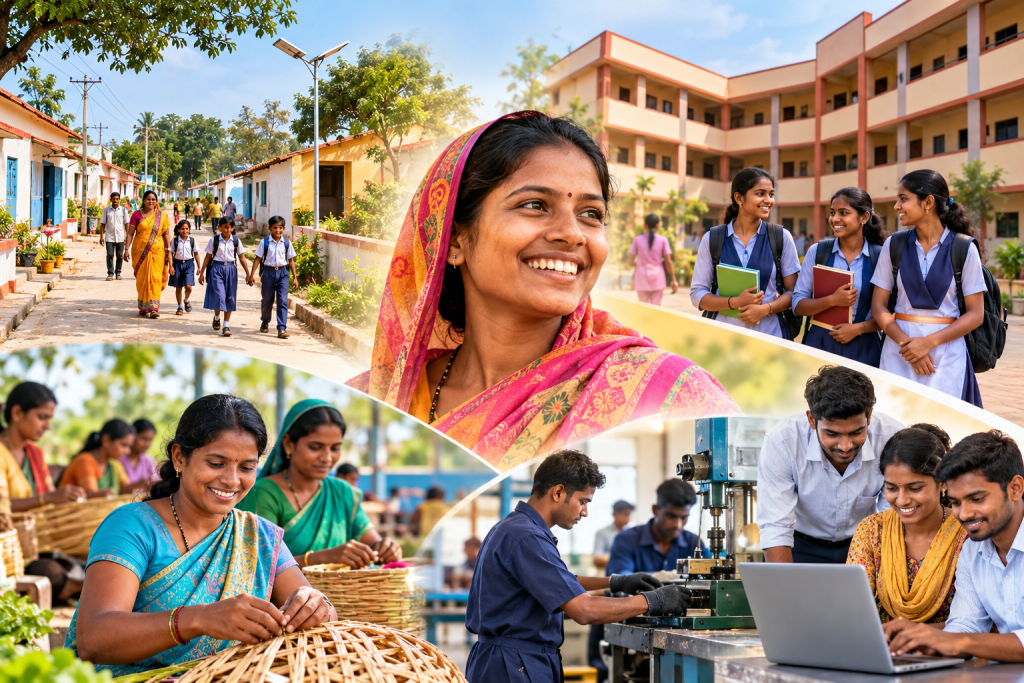
Scheduled Castes (SCs), who constitute 16.6 per cent of India’s population, have historically faced barriers to socio-economic advancement and inclusion. Addressing these disparities is important for ensuring social justice, equal opportunity and broader participation in India’s development journey. Recognising these development gaps, the Government of India launched the Pradhan Mantri Anusuchit Jaati Abhyuday Yojana (PM-AJAY) to promote the overall socio-economic and educational development of Scheduled Caste communities.
Launched in FY 2021-22, PM-AJAY is a 100 per cent centrally sponsored scheme implemented by the Ministry of Social Justice and Empowerment. The scheme focuses on reducing poverty, creating employment and livelihood opportunities, improving infrastructure and essential services in SC-dominated areas, and promoting education among Scheduled Caste communities.
PM-AJAY was formed by merging three erstwhile centrally sponsored schemes — Pradhan Mantri Adarsh Gram Yojana (PMAGY), Special Central Assistance to Scheduled Castes Sub Plan (SCA to SCSP) and Babu Jagjivan Ram Chhatrawas Yojana (BJRCY).
47,243 villages covered under Adarsh Gram component
Under the Adarsh Gram component, PM-AJAY has covered 47,243 villages, benefiting more than 47.79 lakh citizens across the country.
A total of 46,944 development works have been completed, while 27,032 Village Development Plans (VDPs) have been prepared. As of September 8, 2026, 18,093 villages have been declared Adarsh Grams.
The component focuses on addressing critical gaps in infrastructure and basic services in SC-majority villages, with the objective of improving living conditions and ensuring access to essential facilities.
Over ₹1,730 crore released to States
The Grants-in-Aid component provides financial assistance for State- and district-level projects aimed at the socio-economic development of Scheduled Castes.
More than ₹1,730 crore has been released directly to States under this component from FY 2021-22 to FY 2025-26. The assistance has extended skilling and livelihood support to more than 2.5 lakh individual and group beneficiaries.
The projects include comprehensive livelihood initiatives, skill development, creation of infrastructure in SC-dominated villages and residential educational facilities.
Under the scheme, priority under the Grants-in-Aid component is given to families and persons with an annual income of up to ₹2.50 lakh per annum. SC members of SC-majority groups are also eligible.
For infrastructure development, villages having 40 per cent or more SC population and a total population of 500 or more are eligible for grants.
785 student hostels completed
Education is another key focus of PM-AJAY, particularly for students belonging to rural and remote areas.
As of September 2026, 785 student hostels have been completed under the scheme.
For FY 2026-27, the Government has allocated ₹61.46 crore in central assistance for construction of two hostel projects, one for girls and one for boys. These projects will provide accommodation to 264 students.
The hostel component is aimed at enabling SC students to access quality education by providing residential facilities, particularly for those from rural and remote areas.
Digital platforms for faster implementation
The Government has also launched the PM-AJAY Mobile App and PM-AJAY Portal to strengthen implementation and monitoring of the scheme.
The digital platforms seek to move the scheme from paper-based processing to an end-to-end digital workflow, enabling real-time processing and improving transparency, monitoring and coordination.
Under the funding framework, up to 50 per cent of funds can be utilised for gap-filling activities in selected Adarsh Gram villages. Up to 5 per cent can be allocated for Technical Support Groups and Project Implementation Units, while up to 2 per cent can be utilised for construction and repair of hostels for Central Institutions.
The remaining funds are allocated for Grants-in-Aid projects at the State and district levels, based on factors including Scheduled Caste population and the ratio of State SCSP to the Annual Plan.
With its focus on livelihood generation, infrastructure development and educational access, PM-AJAY seeks to strengthen socio-economic opportunities for Scheduled Caste communities. The scheme combines targeted financial assistance, village-level development and digital monitoring to improve implementation and support last-mile delivery.