
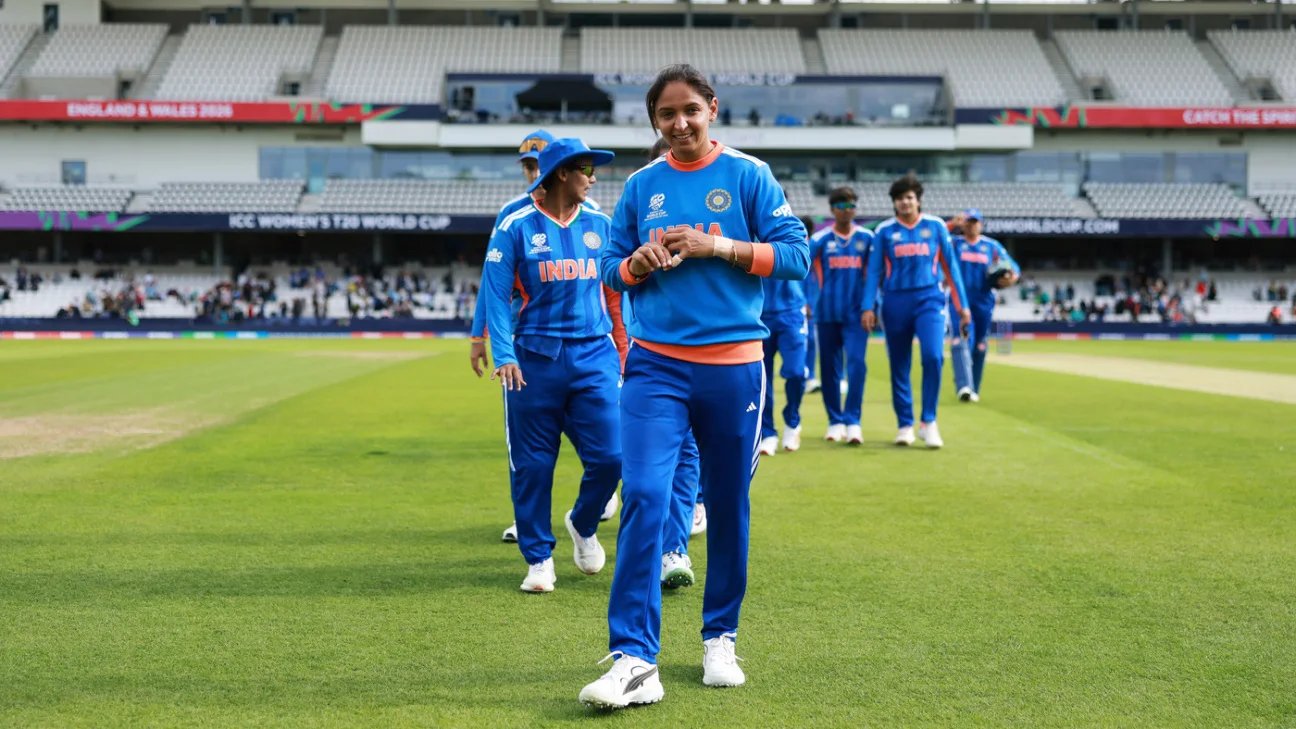
Harmanpreet was part of five T20 World Cups before she was captain. India made the semi-finals twice (2009 and 2010) and were knocked out in the group phase thrice after that. None of those campaigns elicited chatter about personnel, performance or the direction the team was headed in. That’s because at the time, the BCCI was, for the most part, simply going through the motions with women’s cricket.
The irony wasn’t difficult to notice. The standards by which she was eventually judged was reflective of what she had helped create as captain.
At the time, Harmanpreet had just taken over as T20I captain, steering the team through a prickly transition and giving it an identity of its own. Most notably under her, India stopped treating Australia as opponents to be admired and became increasingly willing to take them on.
This is something even a serial world-beater like Alyssa Healy acknowledged. Her run-ins with Harmanpreet on the field – most memorably during the Mumbai Test of 2023 – were a sign that India were standing up to Australia. And Harmanpreet herself seemed to reserve something extra for those contests, mostly with the bat, sometimes with the ball, and always with her body language.
Be it the T20 World Cup opener in Sydney in 2020, the gold-medal bout at the Commonwealth Games in Glasgow in 2022, or the semi-final of the T20 World Cup in 2023 in South Africa… the examples are plenty. It came as no surprise then that after years of running them close, India eventually tore the cloak of invincibility off Australia on that October night in Navi Mumbai last year.
That self-belief took time to translate into results, and it wasn’t confined to just India’s contests against Australia. It was evident in other decisions, like the players Harmanpreet fiercely backed or the style of cricket she wanted the team to play, and spoke of publicly.
She set the tone herself on her T20 World Cup captaincy debut in 2018, striking an extraordinary century against New Zealand in Guyana. It was only slightly less outrageous than the 171 not out in Derby a year before, and it set India off as they broke a three-edition wait for a semi-final appearance.
Harmanpreet was willing to push for young players, back an aggressive approach, and steer India away from the conservatism that had sometimes defined them. Her faith in a 15-year-old Shafali Verma after a handful of exhibition games at the Women’s T20 Challenge in 2019 was one example. Shafali represented a different sort of cricketer: fearless, attacking and seemingly unburdened by the stage or the occasion.
In more recent years, while she was the big sister of a team in transition, Harmanpreet’s own batting suffered somewhat. And for someone judged against the lofty standards she herself had set, it was always an uphill climb
Late last year, when India needed a ready replacement for the injured Pratika Rawal during the knockout phase of the 50-over World Cup, Harmanpreet pushed for Shafali’s return. It was no surprise Shafali was one of the first team-mates to acknowledge Harmanpreet’s contribution on social media on Tuesday.
With Mumbai Indians in the WPL, Harmanpreet won two titles (2023 and 2025), showing that the leadership qualities that defined her were not confined to international cricket. She built a side with a clear identity in mind, managed players from different backgrounds and delivered in a competition where expectations were immense.
In her early days as captain, Harmanpreet sacrificed the No. 3 position in T20Is to serve the team’s need for lower-order firepower. To an extent, this also meant India didn’t fully benefit from Harmanpreet’s T20 abilities during her peak.
In more recent years, while she was the big sister of a team in transition, Harmanpreet’s own batting suffered somewhat. And for someone judged against the lofty standards she herself had set, it was always an uphill climb.
Her T20I record, for example, suggests her striking power was on the wane since 2024. And it has stuck out because India haven’t beaten England, Australia, South Africa or New Zealand at T20 World Cups since 2020. This is something no Asia Cup or Asian Games gold can mask. She has also continued to battle increasing troubles with her ankle and knee lately.
When Harmanpreet got the T20I job in 2016 and eventually across formats in 2022, she was the sole commander-in-chief; since then, she has captained a team with increasingly assured leaders within the set-up.
Mandhana – who was named her successor on Tuesday evening – has been captain-in-waiting for half-a-decade, and her twin WPL triumphs with Royal Challengers Bengaluru have made it tough for the selectors to look away. Then there’s Jemimah Rodrigues, who showed strong glimpses of her leadership with Delhi Capitals this season, seamlessly taking over from five-time world champion Meg Lanning.
In any case, at 37, Harmanpreet had to make a decision sooner rather than later, especially with the next T20 World Cup and the Los Angeles Olympics not far away.
That the announcement was made so quietly was a credit to both Harmanpreet and the BCCI. Maybe the call could have been taken earlier, but Harmanpreet is hardly the first player stuck trying to fight the tide in the sunset of their career.
Scrutiny over the captaincy, and much else, in Indian women’s cricket hasn’t been higher than it has been in recent times. Harmanpreet has often been pitted against heir-apparent Mandhana, and relentless social media storms only magnified this.
For the longest time, though, both players have put the chatter aside, at least publicly. Whatever the noise, it has rarely appeared to come in the way of what the team needed. But recently, Mandhana has suggested more than once that she was ready for the captaincy.
As Harmanpreet steps down, it’s hard to imagine a situation where she won’t be backed to rediscover the fearless, free and flamboyant version of herself from her early days. If she can do that, India may yet benefit.
For now, she leaves behind – while remaining part of – a side that is confident, has an identity and is expected to win titles, not merely compete. And that could be her biggest legacy as a leader.
Shashank Kishore is a senior correspondent at Cricinfo