

The Ministry of Electronics and Information Technology
(“MeitY“) has released the comprehensive
‘India AI Governance Guidelines’
(“Guidelines“), establishing the
foundational policy for the development and deployment of
Artificial Intelligence (“AI“) in India.
Developed by a Drafting Committee
(“Committee“) set up by MeitY in July
2025, the framework is a strategic, coordinated, and
consensus-driven approach intended to balance rapid AI innovation
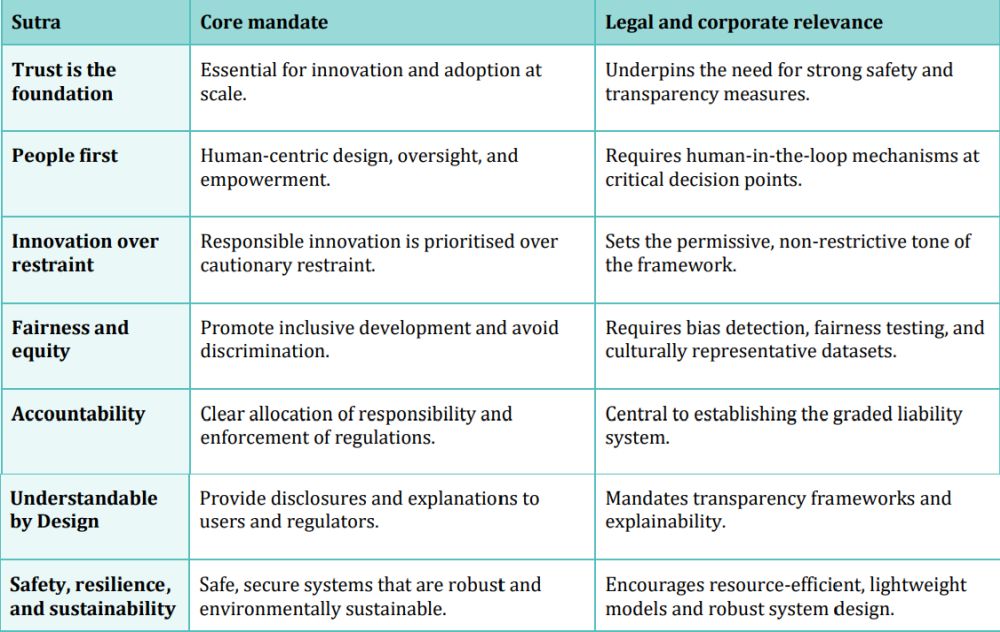
with accountability and safety. It is anchored in 7 (seven) core
principles, or “sutras”, developed based on the FREEAI
Committee Report issued by the Reserve Bank of India
(“RBI“). These sutras (explained below)
establish an agile, balanced and pro-innovation philosophy that
leverages existing statutes and sectoral regulators rather than
proposing a new, all-encompassing AI law at this stage. The
ultimate objective is to harness AI as a force multiplier in
achieving the national aspiration of Viksit Bharat by 2047,
ensuring its benefits are inclusive, safe, and globally
competitive.
Foundational principles: The 7 (seven) sutras
The governance philosophy is grounded in 7 (seven) guiding
principles (sutras), adapted for cross-sectoral applicability:
The Policy architecture: Pillars of governance
The Committee’s recommendations span across the following 3
(three) domains:
- Enablement (infrastructure and capacity
building): Focuses on expanding access to foundational
resources, driving skill development, and integrating AI with
digital public infrastructure for scale and inclusion. - Regulation (policy and risk mitigation): The
strategy favors relying upon existing laws over creating a new AI
Act at this stage. It emphasises developing an India-specific risk
assessment framework based on empirical evidence of harm. - Oversight (accountability and institutions):
Requires organisations to adopt a graded liability system
proportionate to function and risk, and the role of various actors
in the AI-chain and their respective compliance with law.
Mandatory and voluntary risk mitigation
Compliance will be a dual effort of mandatory legal adherence
and voluntary transparency.
- Content authentication (deepfakes): Given the
acute threat of deepfakes, the industry is directed to explore
techno-legal solutions like watermarks and unique identifiers,
aligning with global standards (e.g., C2PA), to authenticate
AI-generated content and establish provenance. - Data protection: The forthcoming
implementation of the Digital Personal Data Protection Act, 2023
should resolve key AI-related issues, such as exemptions for
training models on publicly available data and the compatibility of
consent and purpose limitation principles with modern AI
workflows. - Copyright: The Committee suggests that the
dedicated DPIIT-committee on AI and copyright consider a Text and
Data Mining (TDM) exception to copyright law, to enable large-scale
innovative model training while protecting content creators. - Transparency and auditing: Firms need to
publish transparency reports (which may be shared confidentially
with regulators, if sensitive) and establish effective,
multi-lingual grievance redressal mechanisms. The Guidelines also
encourage algorithmic auditing and self-certifications as
accountability mechanisms.
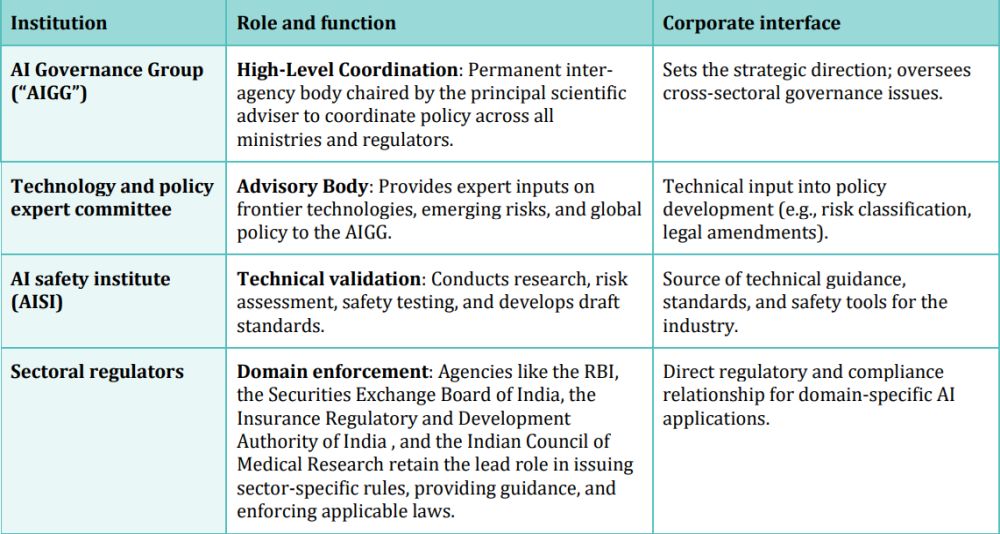
The institutional architecture for oversight
The framework mandates a ‘whole-of-government’
institutional approach, which includes:
Conclusion
The Guidelines signal a clear direction, that corporate India
must immediately focus on embedding the 7 (seven)sutras into their
AI lifecycle management, prioritise transparency, and prepare for
differentiated accountability enforced by their respective sectoral
regulators. The flexibility offered through these Guidelines is a
strategic window for responsible self-regulation before mandatory,
binding rules are introduced.
The content of this article is intended to provide a general
guide to the subject matter. Specialist advice should be sought
about your specific circumstances.
The content of this article is intended to provide a general guide to the subject matter. Specialist advice should be sought about your specific circumstances.