
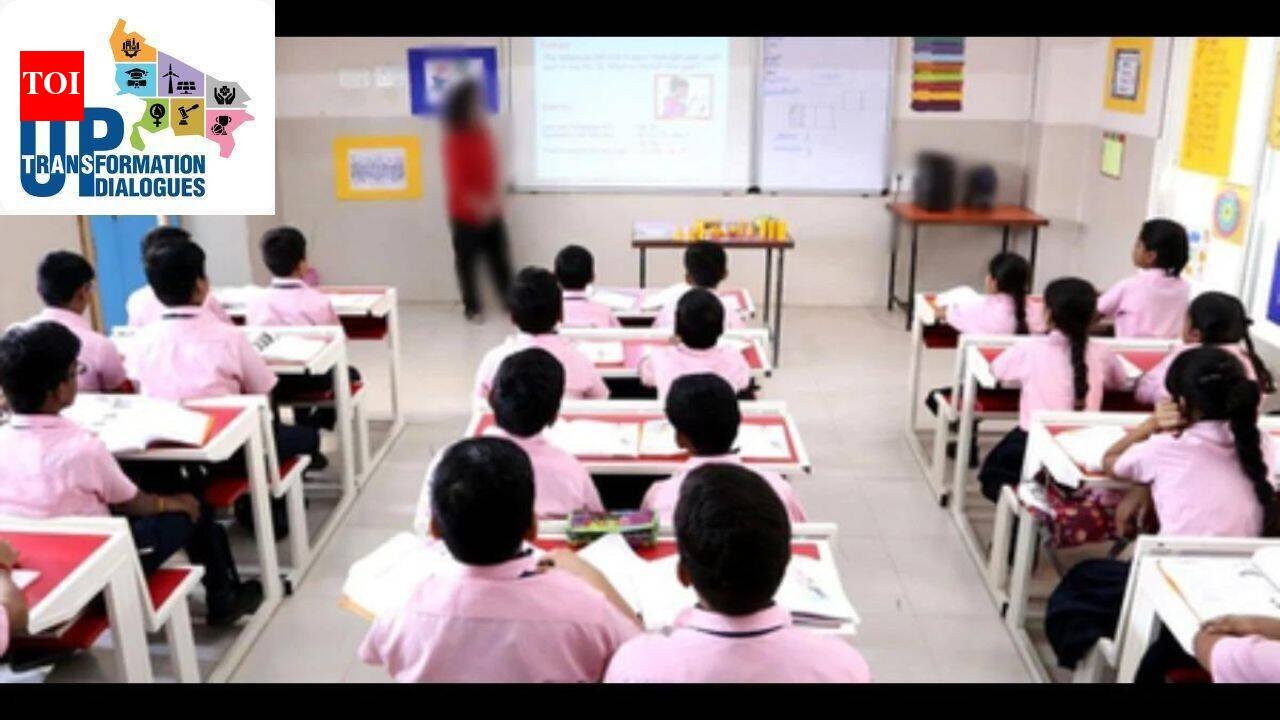
Over the last nine years, Uttar Pradesh has witnessed a gradual transformation in its school education system, with emphasis moving beyond enrolment and basic infrastructure towards learning outcomes, technology, skills, experiential education and greater community participation.The PM SHRI (PM Schools for Rising India) initiative has emerged as an important part of this transition, seeking to develop selected government schools as model institutions that demonstrate the principles of the National Education Policy (NEP) 2020. It is important to note that PM SHRI itself was approved by the Union Cabinet in September 2022.Thus, while the last nine years provide the larger context of educational reforms in Uttar Pradesh, the PM SHRI-specific journey in the state is principally from 2022 onwards. The scheme envisages more than 14,500 exemplar schools nationally over the 2022-23 to 2026-27 period, with the selected institutions serving not only their own students but also demonstrating practices that can be adopted by neighbouring schools.For Uttar Pradesh, the importance of the programme is particularly significant because of the state’s enormous school-age population and the scale of its government-school network. The first phase of PM SHRI selection covered 928 schools in Uttar Pradesh, comprising 842 elementary schools and 86 secondary/senior secondary schools.The state formally launched these PM SHRI schools in Lucknow in January 2024 in the presence of Union Education Minister Dharmendra Pradhan and Chief Minister Yogi Adityanath. The programme has subsequently expanded. At present, 1,565 PM SHRI Schools are being covered in Uttar Pradesh, giving the state a substantial network of institutions through which the PM SHRI model can be implemented and demonstrated.The focus is not merely on constructing new school buildings. Rather, the idea is to strengthen existing government schools and turn them into vibrant, inclusive and future-ready learning environments.From basic schooling to holistic educationOne of the most important changes in the state’s school education approach during the period has been the widening definition of educational quality. A good school is increasingly being viewed not simply as a place where children attend classes, but as an environment where academic learning, creativity, sports, technology, vocational exposure, life skills and citizenship values develop together. This is central to the PM SHRI philosophy.The official PM SHRI framework identifies several quality benchmarks, including implementation of NEP 2020, tracking of enrolment and learning progress, exposure to 21st-century skills, access to sports, arts and ICT facilities, sustainable and green-school practices, links with higher educational institutions and connections with local entrepreneurial ecosystems. For Uttar Pradesh, this provides an opportunity to create demonstration schools in both urban and rural areas where modern pedagogy can coexist with local culture and community participation.The state’s PM SHRI schools are therefore being developed around concepts such as Bal Vatika, smart classrooms, science laboratories, digital libraries, sports facilities and integrated campuses. When the first phase was launched in January 2024, the Uttar Pradesh government stated that these facilities would be introduced as part of the transformation of selected schools into integrated institutions providing holistic education.Learning by doing becomes the new classroom approachA notable achievement of PM SHRI implementation in Uttar Pradesh has been the emphasis on experiential learning. The national PM SHRI framework seeks to move students away from purely textbook-based learning towards activities that encourage curiosity, experimentation, problem-solving and critical thinking.The PM SHRI schools featured in the Ministry of Education’s national documentation from Uttar Pradesh have adopted the “Students Learning by Doing” approach. Building as Learning Aid (BALA) activities are also being used to turn the physical school environment into an educational resource, with visual material on subjects such as mathematics, language, environmental protection, water conservation, cleanliness and waste management.Kitchen and herbal gardens provide another opportunity for students to learn about nature, nutrition and sustainability through direct experience. Such initiatives are important because they make learning more connected to children’s everyday surroundings. A school garden, for example, can become a practical laboratory for lessons on plants, soil, water and nutrition, while a science activity can transform an abstract concept into something that students can observe and test themselves.Digital and scientific learningTechnology is another major component of the PM SHRI transformation. Smart classrooms, digital resources, ICT facilities and science laboratories are intended to expose students to contemporary methods of learning and prepare them for an increasingly technology-driven economy. For Uttar Pradesh, this has particular relevance because the state has a very large rural student population.Bringing digital learning facilities to selected government schools can help narrow the gap between children studying in different socio-economic environments. The objective is not technology for its own sake. PM SHRI’s quality framework connects ICT with student-centred pedagogy, learning progress and 21st-century skills. The larger purpose is to create students who can learn independently, communicate effectively, solve problems and adapt to new technologies.Green and sustainable schoolsEnvironmental awareness has also become part of the PM SHRI school model. Schools in Uttar Pradesh have participated in activities under Swachhata Pakhwada, while kitchen gardens, herbal gardens and BALA-based environmental learning are being used to make sustainability part of everyday school life.This approach is significant because children learn environmental responsibility not only through textbooks but through practices inside their own school. Clean surroundings, waste management, water conservation, gardening and responsible use of resources can become part of the school culture.The objective fits closely with the PM SHRI vision of developing sustainable and green schools, while simultaneously strengthening students’ understanding of their responsibilities towards nature and society.Teachers at the centre of transformationNo school reform can succeed without teachers. PM SHRI therefore places considerable emphasis on changes in pedagogy, teacher capacity and continuous monitoring. The scheme has a multi-level monitoring mechanism involving the Ministry, state, district and block structures, supported by the School Quality Assessment Framework.This framework looks at curriculum, pedagogy, assessment, infrastructure, human resources, inclusion and other aspects of school quality. In Uttar Pradesh, the PM SHRI network provides a platform through which innovative teaching practices can be demonstrated and subsequently shared with other schools.The model is therefore intended to have an impact beyond the selected institutions. This “demonstration effect” is one of the most important features of the scheme. If an innovative classroom practice, science activity, digital teaching method or community partnership works effectively in one PM SHRI school, it can provide a practical example for neighbouring government schools.Greater focus on inclusion and child developmentPM SHRI also seeks to make schools more inclusive. The national framework calls for attention to diverse backgrounds, multilingual needs, different academic abilities, gender equity and children with disabilities. It also envisages counselling and career guidance for students.This broad approach is particularly relevant to Uttar Pradesh, where schools serve children from highly diverse social, economic and geographical backgrounds. The objective is to ensure that the school environment is welcoming and supportive rather than focused only on academic examination results. Sports, arts, cultural activities, creativity and citizenship education are consequently treated as integral components of the educational experience.From school participation to community participationThe next phase of Uttar Pradesh’s PM SHRI journey is increasingly placing the community at the centre of school development. The proposed “Mera Gaon–Mera Vidyalaya” programme in November across 1,565 PM SHRI Schools is an important example. A financial provision of ₹46.95 lakh has been earmarked for organising the programme.The initiative seeks to bring together schools, parents, School Management Committees, Gram Panchayat representatives, local public representatives, retired officials and employees, teachers and other members of the local community. Activities such as rallies and prabhat pheris, plays, storytelling sessions, sports competitions, poster and artwork exhibitions, signature campaigns and selfie points are planned. Outstanding students will also be felicitated.The programme goes beyond a ceremonial school event. Its larger objective is to create a relationship between the school and the community around it. Parents and villagers can understand school activities and government programmes better, while schools can draw upon local knowledge, experience and support.Enrolment, retention and continuityCommunity engagement also has a direct connection with enrolment and retention. The PM SHRI framework places emphasis on tracking each child’s enrolment and learning progress. The “Mera Gaon–Mera Vidyalaya” initiative further strengthens this objective by encouraging students completing Classes 5, 8 and 10 to continue their education by enrolling in Classes 6, 9 and 11 respectively.Such interventions are important because educational progress depends not only on what happens inside the classroom but also on whether children remain connected to the education system during transition points. The involvement of parents and village communities can help identify children who may be at risk of dropping out and encourage their continuation into the next stage of education.Child rights and responsible citizenshipAnother dimension of the programme is awareness of child rights. Signature campaigns and community activities are being planned to sensitise parents and local communities about children’s rights and their responsibilities towards children’s education and protection. This fits into the broader PM SHRI objective of creating responsible citizens.The official framework places emphasis on citizenship values, fundamental duties, social responsibility, inclusion and respect for India’s diversity. Thus, the PM SHRI school is envisioned not merely as an academic institution but as a community institution that contributes to the social development of its locality.A model for the wider school systemThe real measure of PM SHRI’s long-term achievement in Uttar Pradesh will lie in whether its innovations influence the wider government-school system. The scheme was designed nationally so that selected schools become exemplars and provide leadership to other schools in their neighbourhoods.An expansion from the first phase of 928 schools to the current 1,565-school network provides a larger platform for this process in Uttar Pradesh. The state can potentially use these institutions as laboratories for innovative pedagogy, digital learning, sports, vocational exposure, green practices and community participation.The experience of PM SHRI also complements the wider school-education reforms undertaken in Uttar Pradesh over the last nine years. The state’s educational transformation has increasingly focused on infrastructure, technology, teacher development, learning outcomes, foundational literacy and numeracy, girls’ education and community participation. PM SHRI adds a new layer by bringing these components together within selected exemplar schools.What next ?The PM SHRI programme is still in its implementation phase, with the national scheme scheduled through 2026-27. Therefore, its ultimate educational impact should be assessed over a longer period rather than only through the number of schools selected or facilities created. Uttar Pradesh government has the immediate priorities are effective utilisation of infrastructure, teacher capacity building, regular assessment of learning outcomes, meaningful parental participation, inclusion of disadvantaged children and systematic sharing of successful practices with neighbouring schools.The “Mera Gaon–Mera Vidyalaya” initiative adds an important social dimension to this process. It recognises that a school cannot operate in isolation from the community it serves. Over the last nine years, the state’s school education journey has increasingly moved from the question of access towards the larger question of quality and outcomes.PM SHRI represents the next stage of that journey: creating schools where infrastructure, technology, experiential learning, sports, arts, sustainability, inclusion and community participation work together. With 1,565 schools now being brought into the state’s PM SHRI framework, Uttar Pradesh has an opportunity to establish a network of model government schools that can influence educational practices well beyond their own campuses.If the innovations developed in these institutions are systematically documented, assessed and replicated, PM SHRI can serve not simply as a programme for selected schools, but as a catalyst for wider improvement in the quality and culture of school education across the state.