
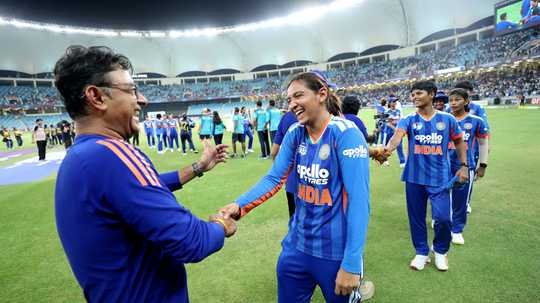
Will the Asia Cup trophy fiasco play out in the Asian Games? That is the obvious question on everyone’s mind as the Indian women’s team, favourites for the gold medal, prepare to take on Bangladesh in the semifinal on Sunday. The Indian women’s team, like the men’s side a year ago, refused to accept the trophy from Mohsin Naqvi in Dubai last Sunday.
There is always a chance that Naqvi, by virtue of being the president of the Asian Cricket Council (ACC), could be an invitee at the Games. Will he be accorded the privilege of presenting the medals in Nagoya? Chances are that he may, well, not be.
With India having strong diplomatic relations with Japan, Dubai is unlikely to be repeated in Nagoya. The two countries recently announced special measures to commemorate 75 years of friendship. As part of this, India, the World’s No. 1 side, agreed to play Japan.
For the reigning world champions to take on an associate nation, ranked 41st, is no ordinary gesture. It involved the governments of the two countries, besides, of course, the Board of Control for Cricket in India (BCCI) and the Japan Cricket Association (JCA) to work out the fixture. The September 22 game, thus, is far from being a routine bilateral match.
Neighbours Nepal, who have been a rising team in world cricket, have not had the opportunity of playing India in a bilateral international so far. Japan has been given such a significant opportunity, and unlikely the country will allow any embarrassment for the Indian side. The Naqvi-led ACC will have little say.
“That is my reading,” said a member of the ACC. “I think Japan will not allow it. India’s gesture of playing Japan will not go unacknowledged.”
The decision on the chief guest for the medal event will, of course, be the prerogative of the Olympic Council of Asia (OCA), but the Japanese Olympic Committee (JOC) and the Aichi-Nagoya Asian Games and Asian Para Games Organizing Committee (AINAGOC) will have a major say in the matter. Both bodies are expected to be mindful of India’s concerns.
The BCCI has stayed clear of the issue. After Friday’s AGM, Devajit Saikia said he would refrain from commenting on a hypothetical situation of India being on the podium and Naqvi presenting the medals. “The teams have to first reach the podium. We will take a call then, taking into account all prevailing factors at that moment. We will cross the bridge only when we reach it,” the BCCI secretary told ToI.
A delegation of the Indian Olympic Association (IOA) is in Nagoya, but sources within the IOA declined to discuss the matter. It is unlikely that the IOA has made a representation to the OCA, JOC or AINAGOC on the issue.
There is also no immediate information on whether Naqvi will travel to Japan at all. A spokesman for the Pakistan Cricket Board (PCB) told Cricbuzz that his visit to Japan is doubtful. “I don’t think so,” he replied to a query from this website. It may well be that the PCB spokesman may not have the travel plans of the country’s Interior Minister. In any case, Naqvi is known to make decisions at the last minute. He landed in Dubai just about 30 minutes before the Women’s Asia Cup final was due to end last Sunday.
The BCCI officials, however, will be there in Nagoya. Saikia himself confirmed that he would travel to Japan on October 1 and stay on for the men’s final, which will be held on October 3. The Indian men’s cricket team is scheduled to travel to Japan late on Saturday night. The two finals are on September 22 (women’s) and October 3.
As previously reported by Cricbuzz on August 12, India and Pakistan teams – both in men and women – are drawn to meet only in a medal contest – either for the gold or for bronze. There is also a possibility that there may be no India-Pakistan matches in Japan at all.